TRADITIONAL AYURVEDIC THERAPIES IN NYON
Specialised Ayurvedic Therapies in Nyon
Targeted, personalised care for your needs
At L’essencce, we offer specialised Ayurvedic therapies such as Netra Basti for the eyes, Kati Basti for the lower back, Janu Basti for the knees, Nasya, Agnikarma and Viddha Karma, to address specific concerns and promote long-term balance and vitality.
Each treatment is selected after a personalised assessment. It may be provided on its own or integrated into an Ayurvedic treatment plan or Panchakarma programme.
Authentic approach
Personalised care
In the heart of Nyon
Ancient wisdom, tailored for today
Balance · Health · Vitality
.webp)
What is a specialised Ayurvedic therapy?
A specialised Ayurvedic therapy is a targeted treatment using medicinal oils, ghee, herbs, powders, heat, steam or the stimulation of specific points.
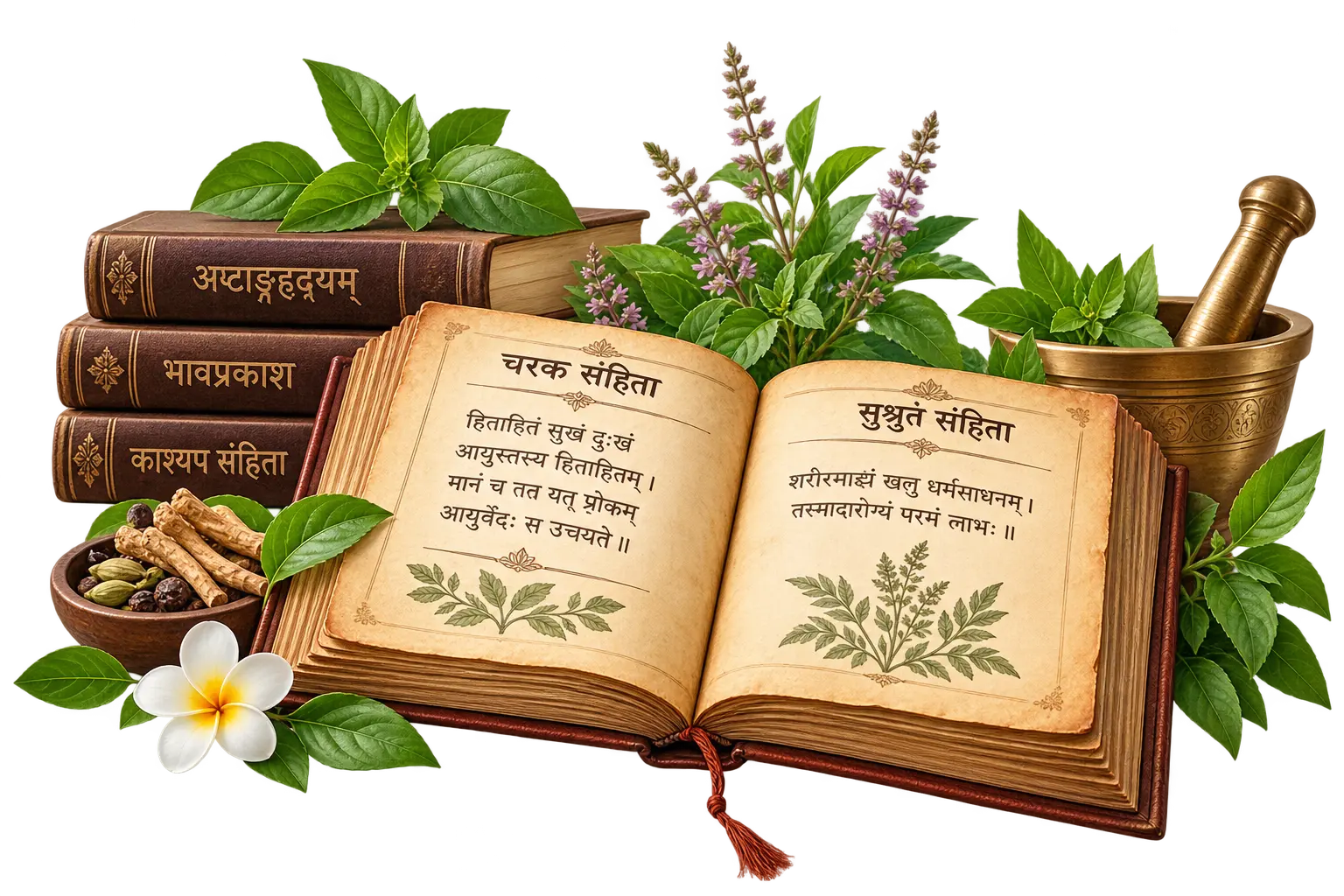
Classical texts
These therapies draw on classical Ayurvedic texts, particularly for Netra Tarpana, Nasya, Swedana and Agnikarma.
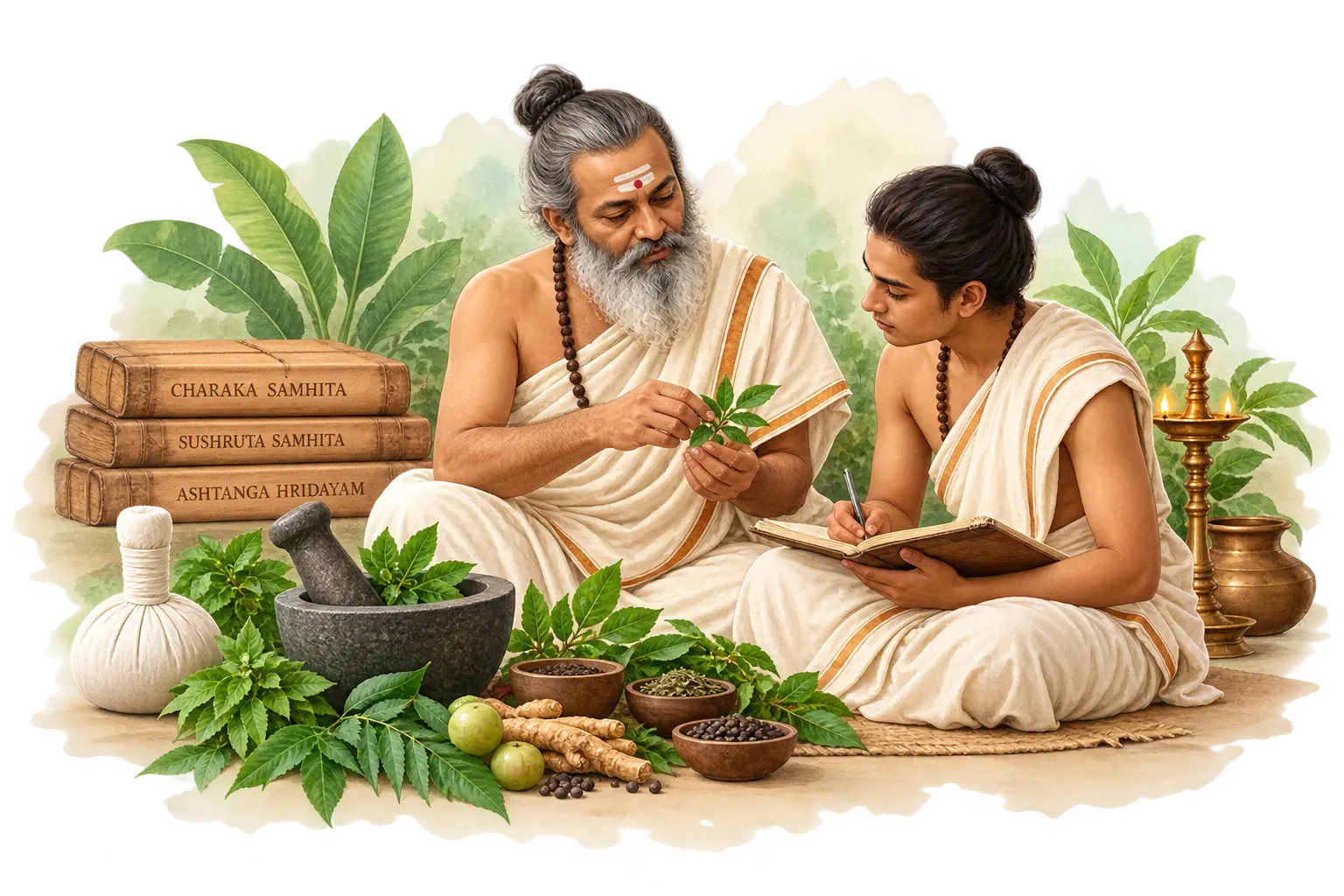
Traditional practice
Traditional clinical knowledge passed down between experienced practitioners over generations.
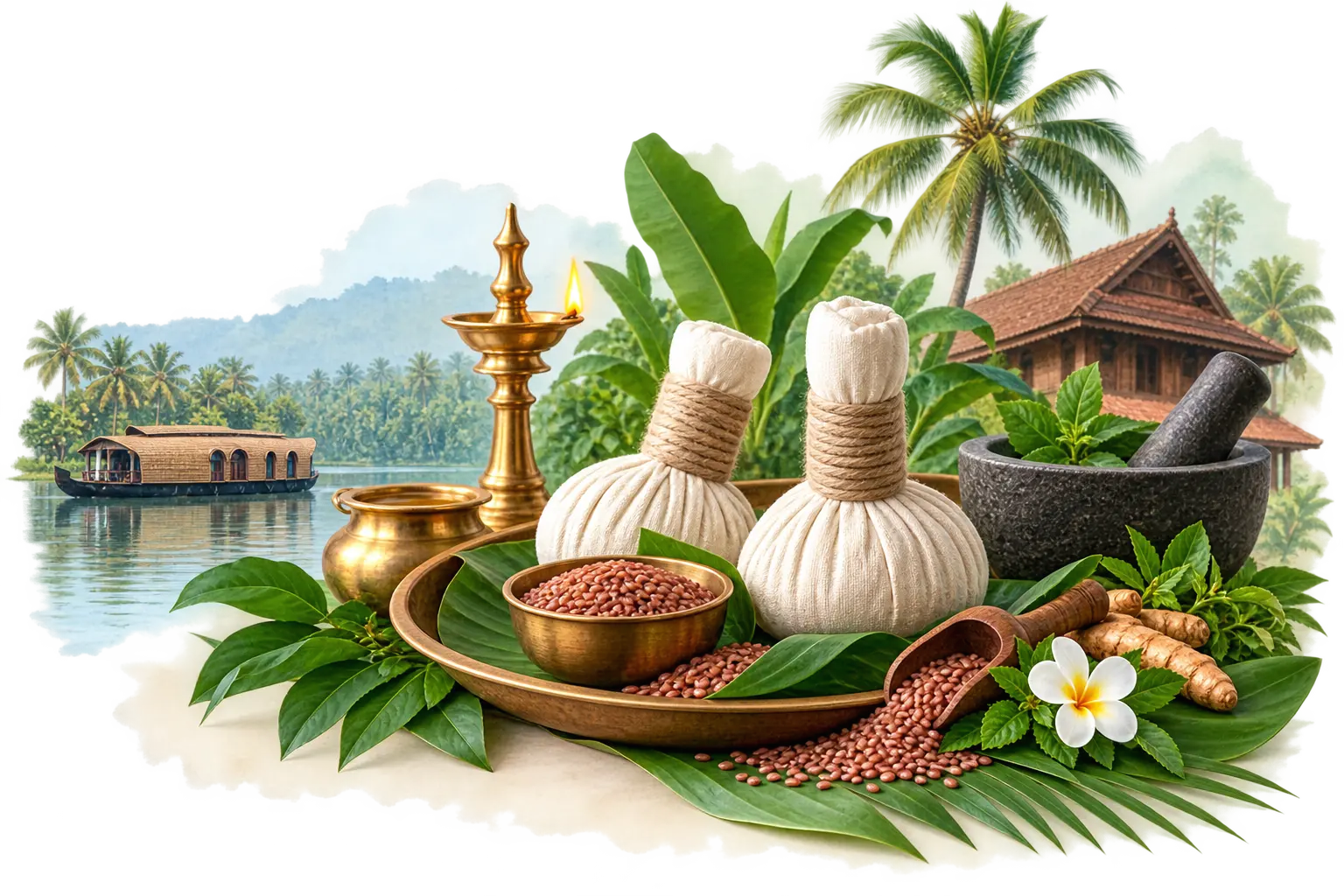
Traditions of Kerala
The therapeutic traditions of Kerala, including Navarakizhi and selected herbal bolus therapies.
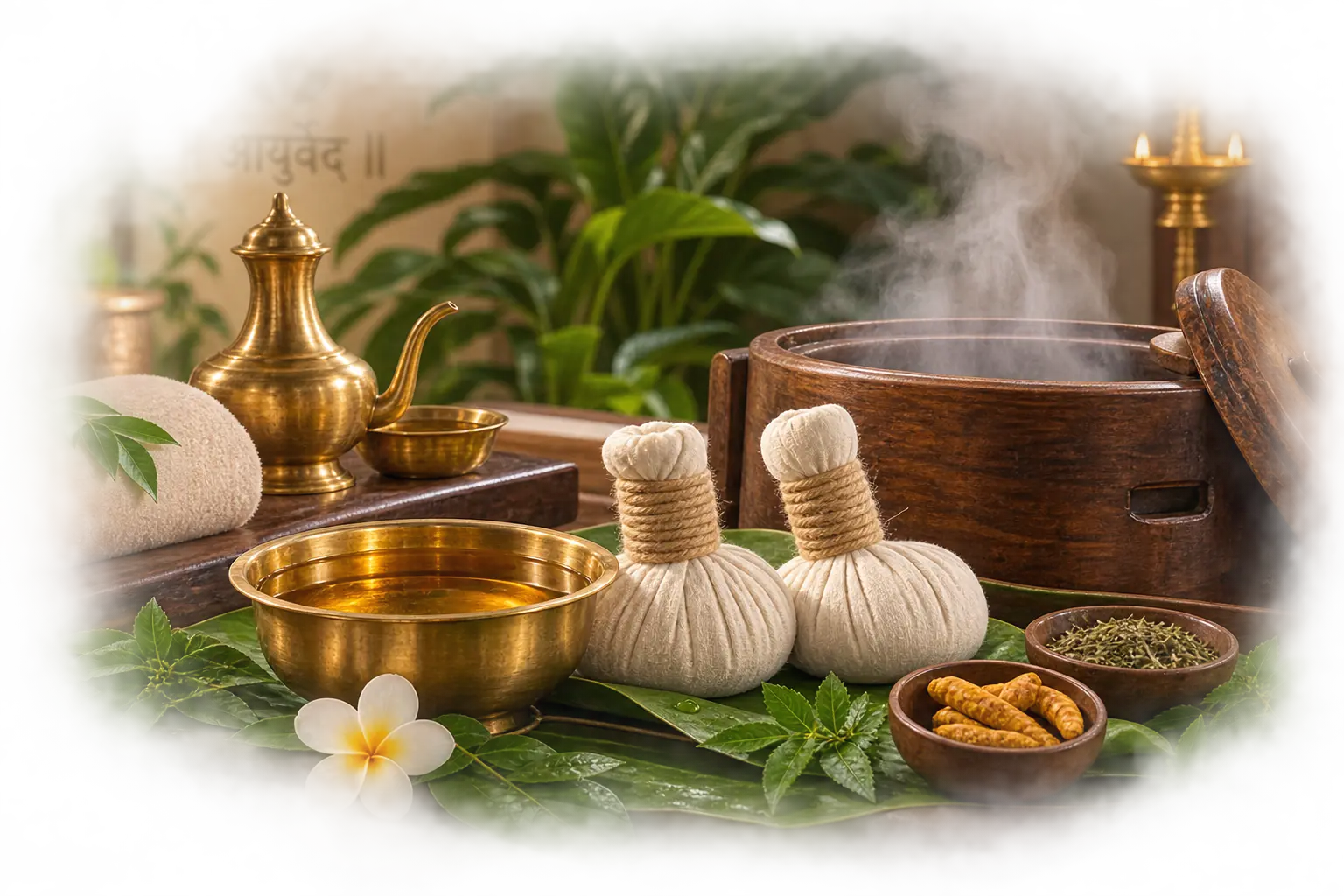
Snehana & Swedana
Local applications developed from the Ayurvedic principles of Snehana — oleation — and Swedana — therapeutic heat.
Which Ayurvedic therapy addresses your needs?
| Your main concern | Therapies assessed for this concern |
|---|---|
|
Tired, dry or screen-strained eyes
|
|
|
Lower-back tension or stiffness
|
|
|
Neck tension or cervical stiffness
|
|
|
Knee discomfort, stiffness or reduced mobility
|
|
|
Nose, sinuses and the ear, nose and throat area
|
Nasya, according to the indication
|
|
Abdominal or navel area
|
|
|
Chest-area tension and need for relaxation
|
|
|
Dryness or discomfort of the ears
|
|
|
Fatigue, weakness or muscular recovery
|
|
|
Need for therapeutic warmth and physical relaxation
|
|
|
Highly localised pain or tension
|
A treatment selected for you, not a standard protocol
This table summarises the traditional indications for the principal Ayurvedic therapies offered in Nyon.
In Ayurveda, an indication means that a therapy is appropriate after the practitioner has assessed your constitution during an Ayurvedic consultation, the stage of the condition, your strength and any contraindications. It is not a promise of results.
The practitioner determines the technique, preparation, temperature, duration and number of sessions at our Ayurvedic centre in Nyon.
.webp)
Main specialised Ayurvedic therapies
Targeted treatments, for lasting results
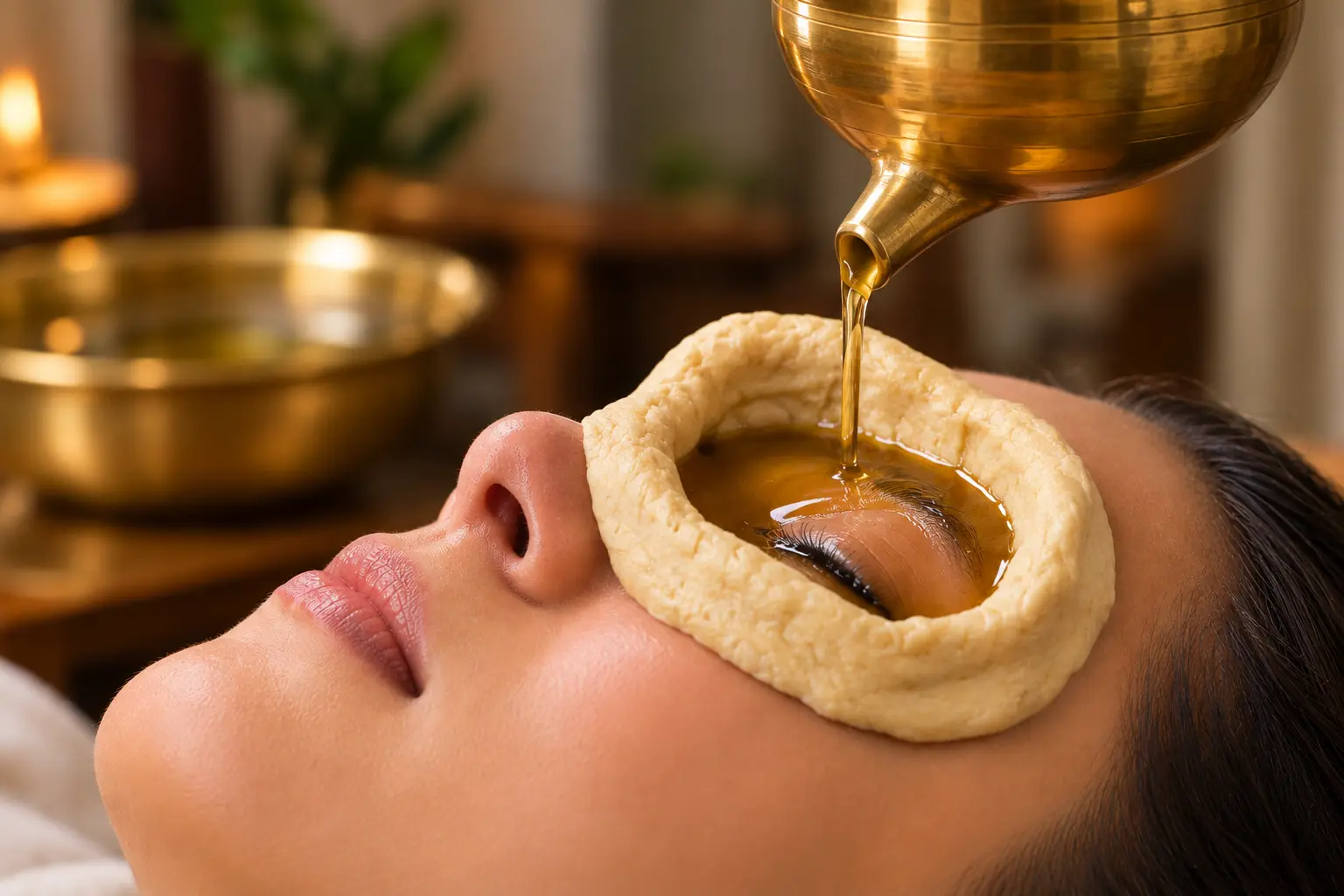
Netra Basti
Ayurvedic eye therapy with warm ghee.
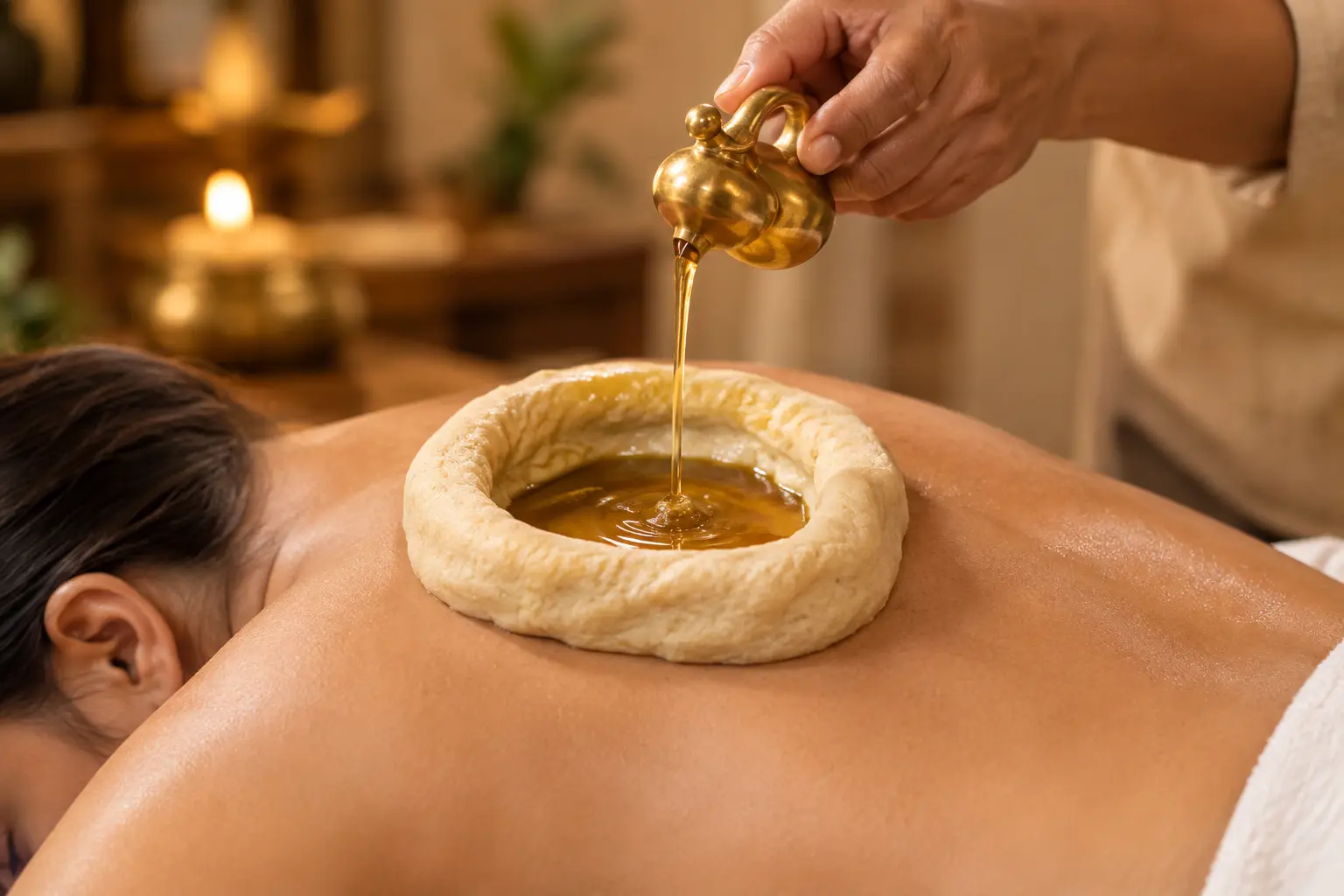
Bāhya Basti
Targeted care for the back and joints.
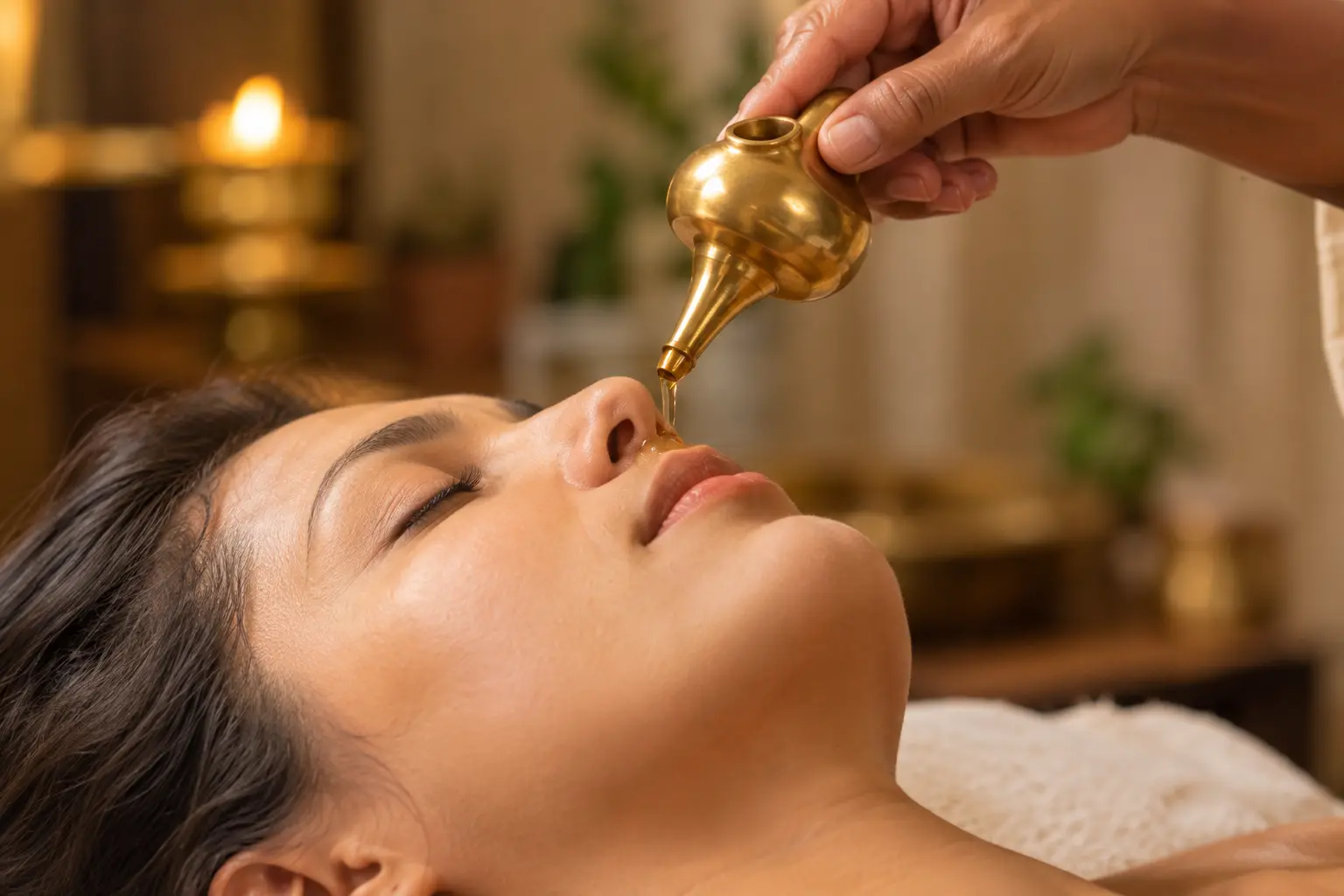
Nasya
Care for the nasal passages and ENT area.
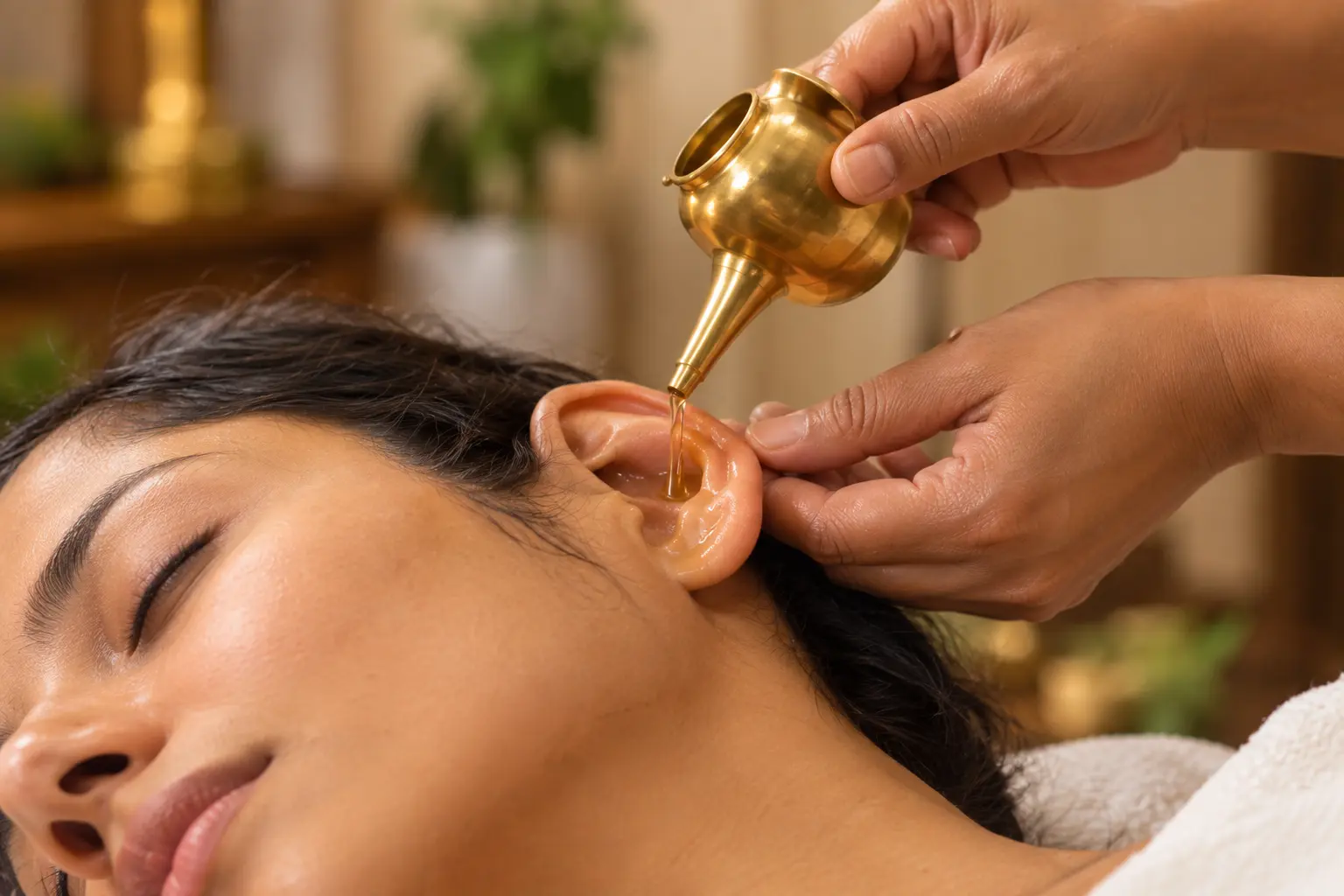
Karna Purana
Ear therapy with warm medicinal oil.
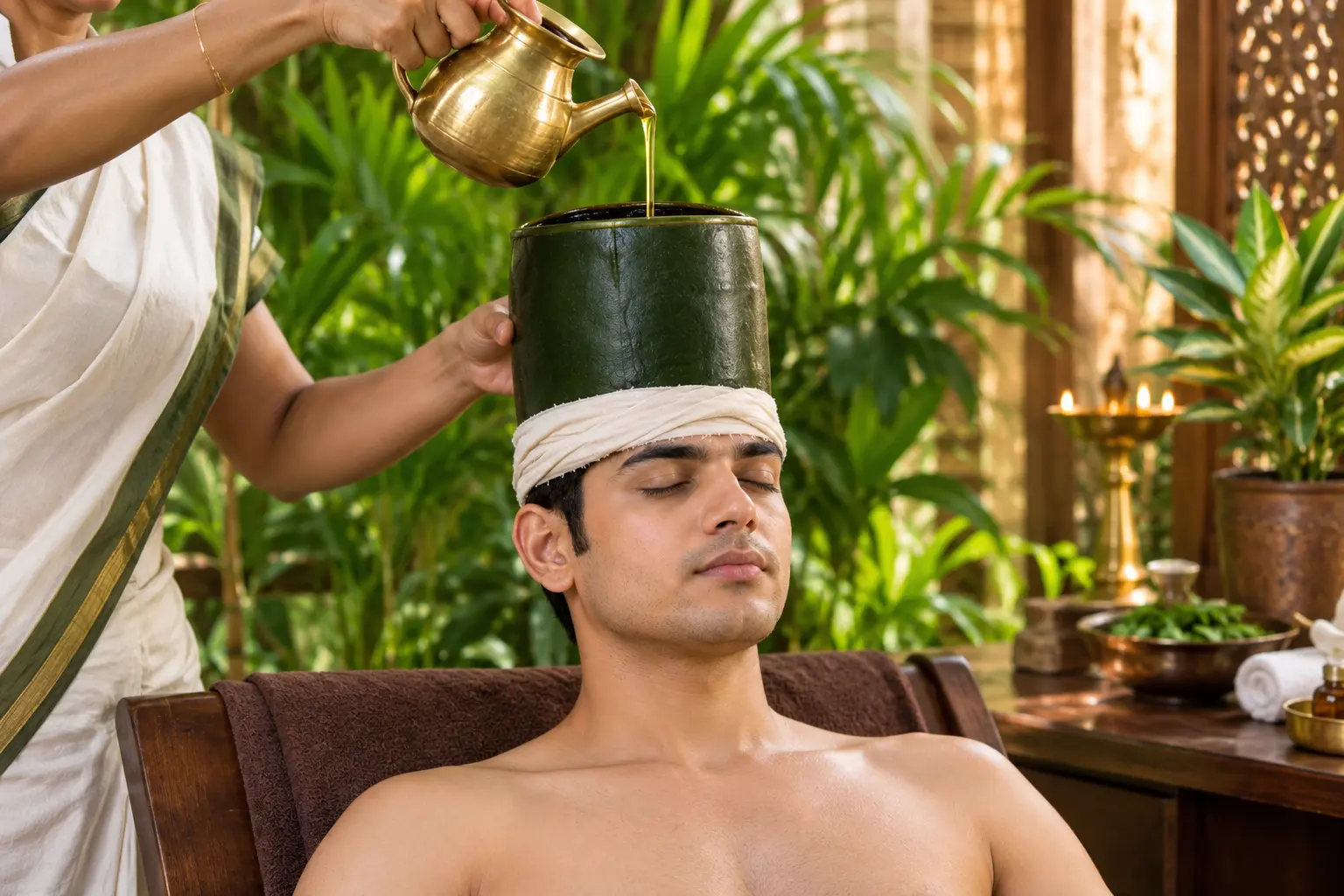
Shiro Basti
Continuous head therapy with warm medicinal oil.
.webp)
Pichu
Localised application of medicinal oil.
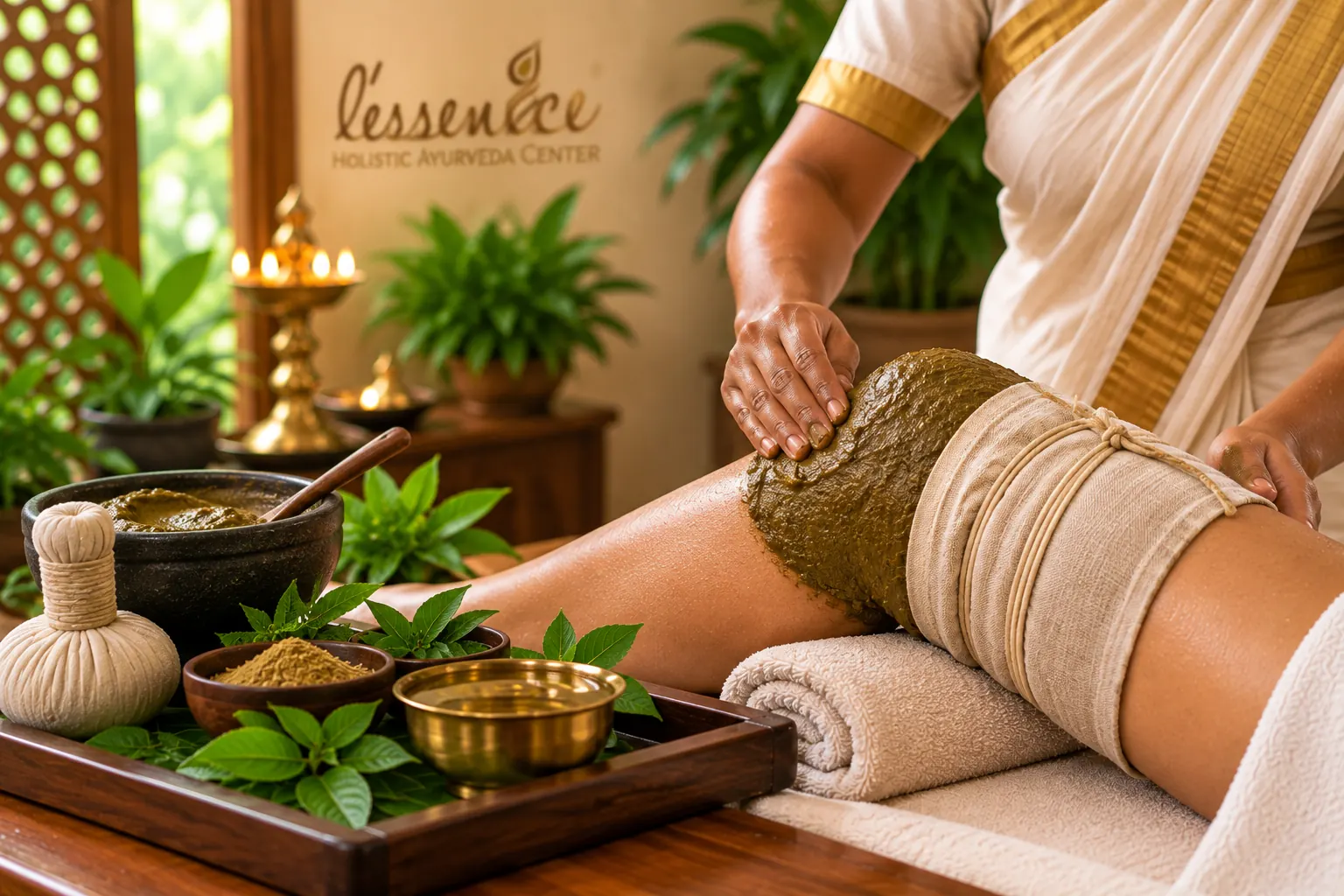
Lepa & Upanaha
Herbal pastes to relieve inflammation.
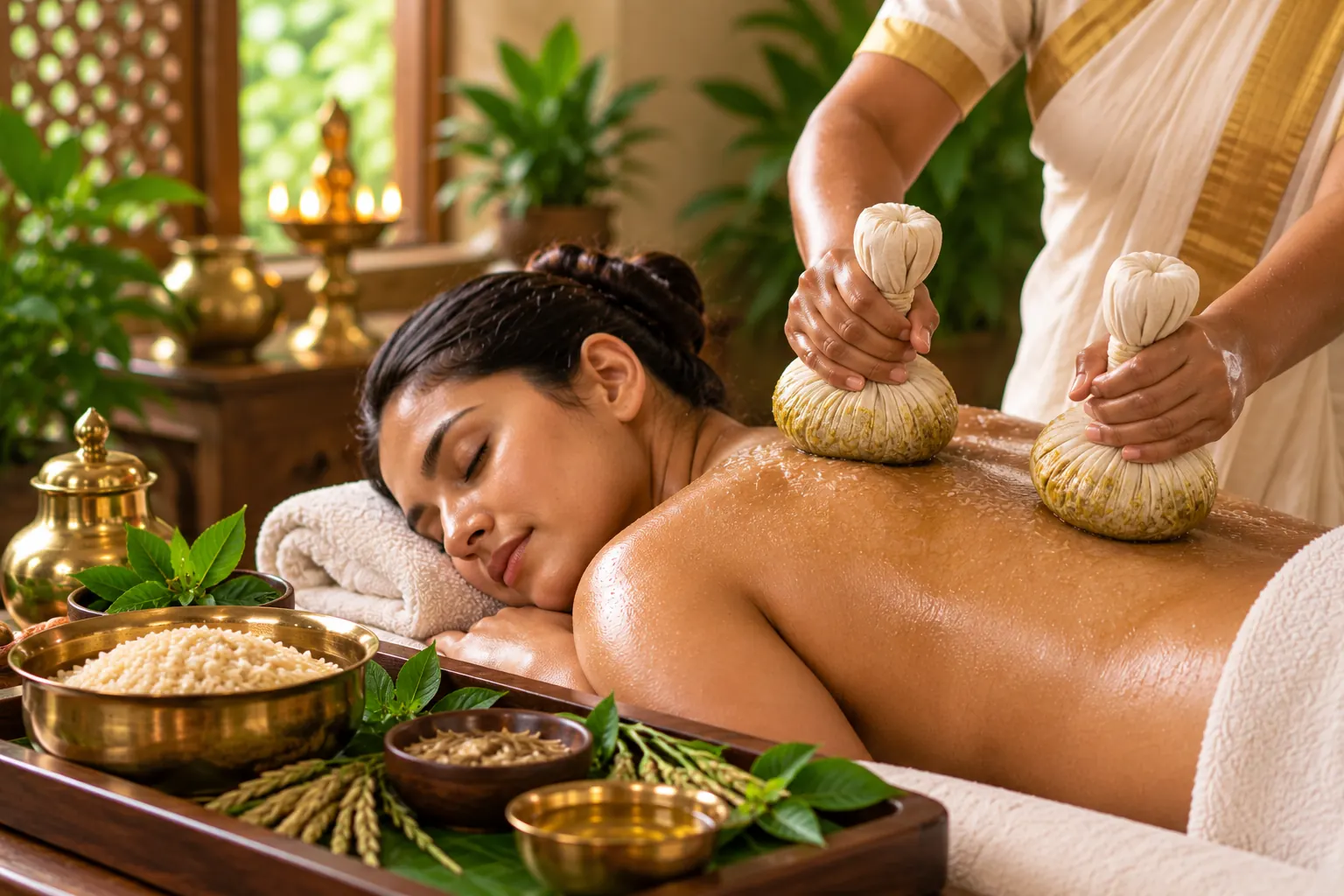
Navarakizhi
Massage with medicinal rice boluses.
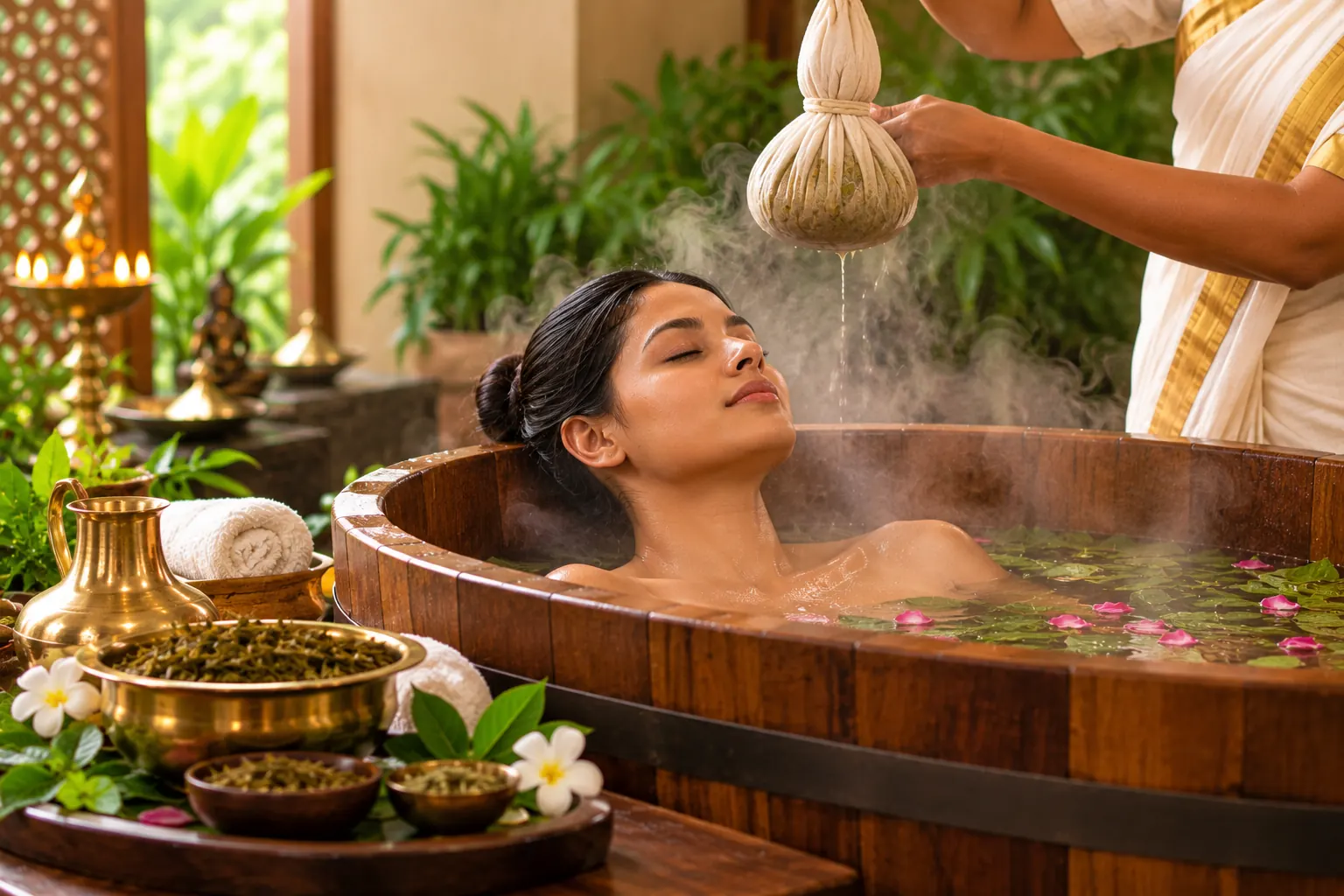
Swedana & Avagaha
Sudation therapies and herbal warm baths.
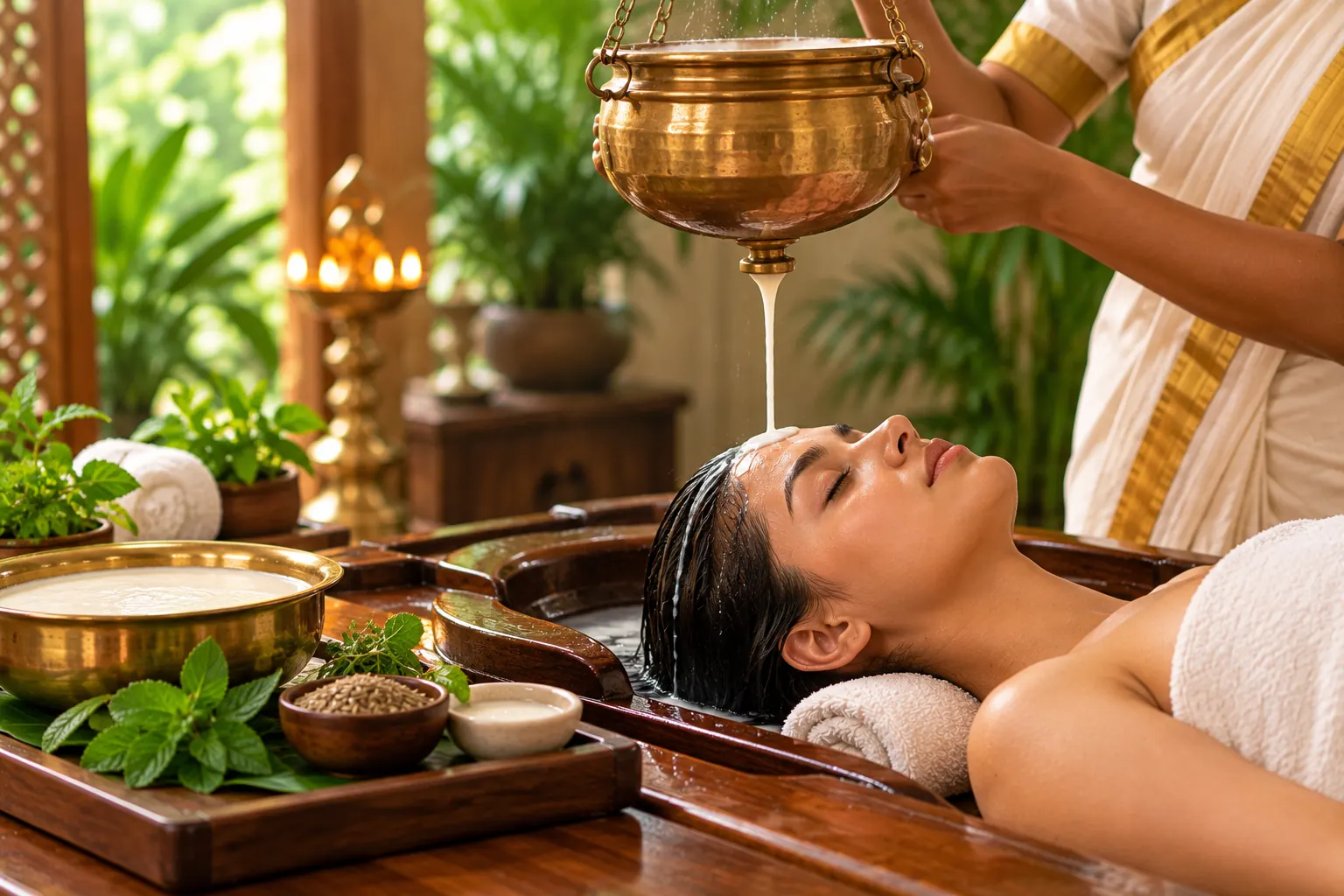
Takradhara
Calming treatment with medicinal buttermilk.
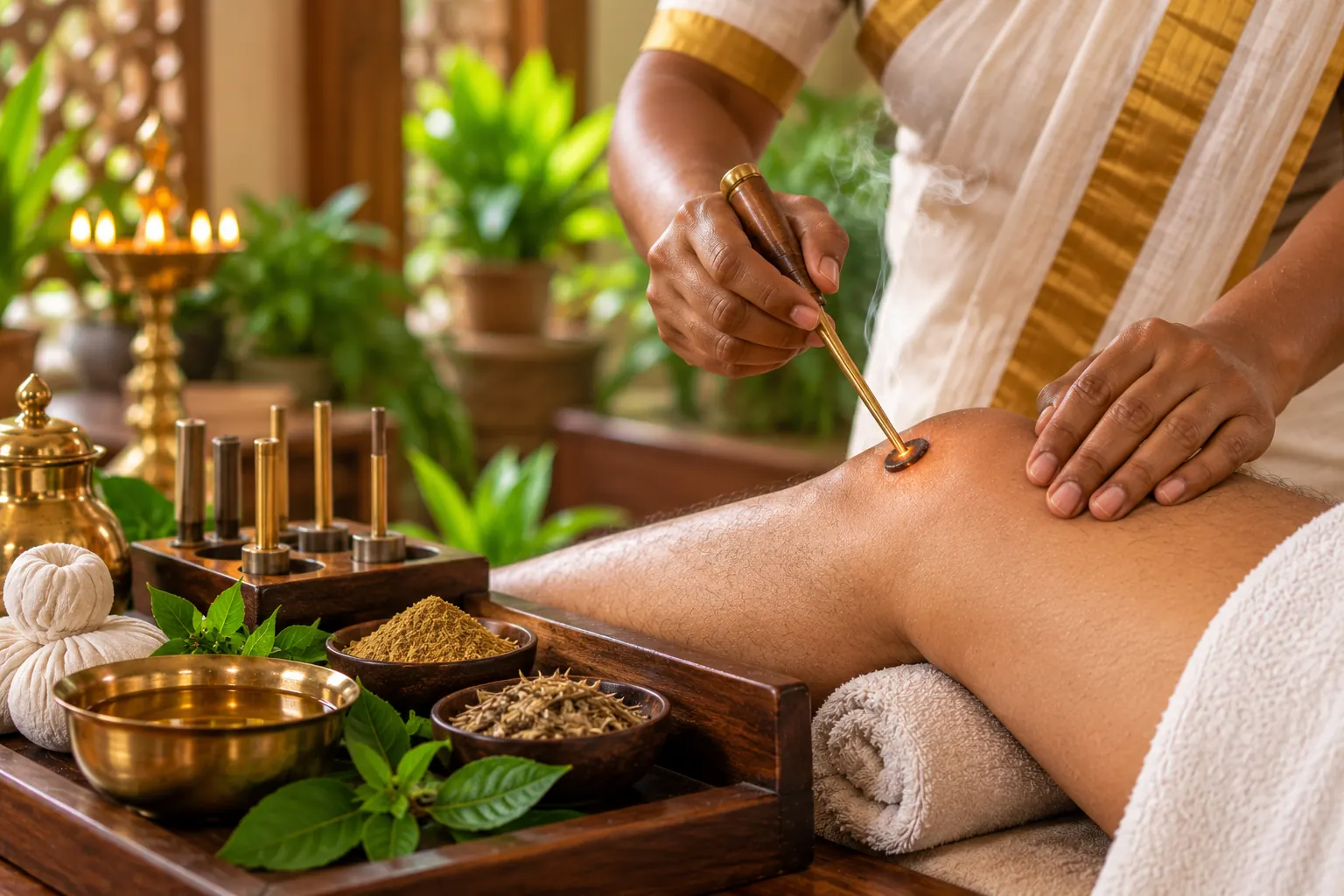
Agnikarma
Thermal stimulation for acute pain points.
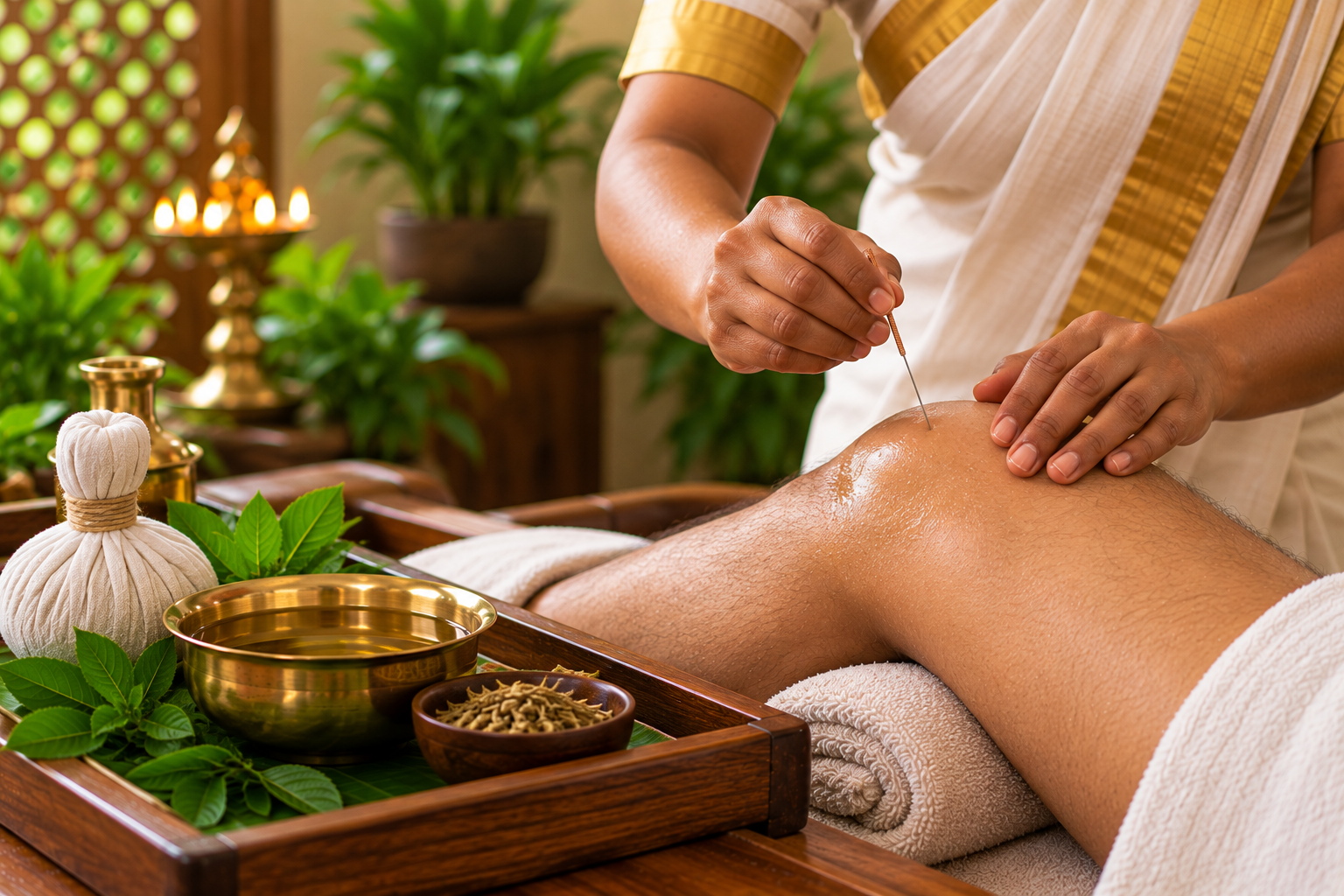
Viddha Karma
Targeted micro-puncture therapy.
Local oil and ghee therapies
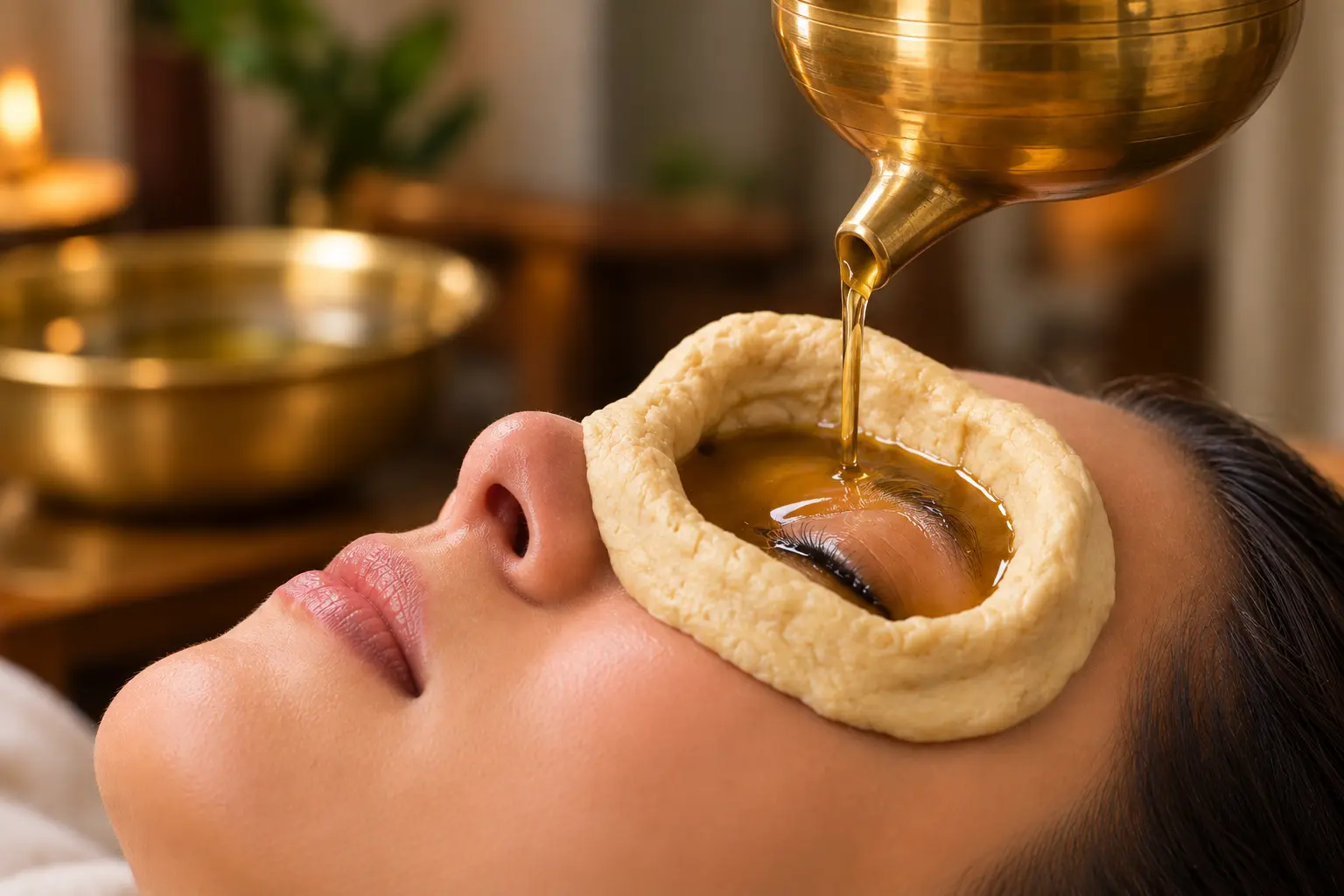
Netra Basti / Akshi Tarpana
Ayurvedic eye therapy with warm ghee
During Netra Basti, warm ghee is gently retained around the eyes within a soft protective ring. The treatment gives the eye area a period of deep rest and nourishment.
Traditional Ayurvedic indications:
- Netra Śrama — eye fatigue, including strain associated with prolonged screen use.
- Śuṣkākṣipāka — dryness and eye discomfort outside an acute inflammatory phase.
- Akṣi Daha — heat or burning sensations after an acute cause has been excluded.
- Tension, heaviness or fatigue around the eyes.
- Nourishing eye care for selected Vata and Pitta imbalances following an Ayurvedic assessment.
 Netra Basti / Akshi Tarpana
The eyes are checked before treatment. Netra Basti is not performed in the presence of an infection, acute irritation, an eye lesion or following recent eye surgery without medical approval. Netra Basti does not replace an examination by an ophthalmologist.
Netra Tarpana / Akshi Tarpana: Suśruta Saṃhitā, Uttara Tantra, Chapter 18, on Kriyākalpa — therapeutic procedures for the eyes.
Bāhya Basti — localised Ayurvedic oil treatments
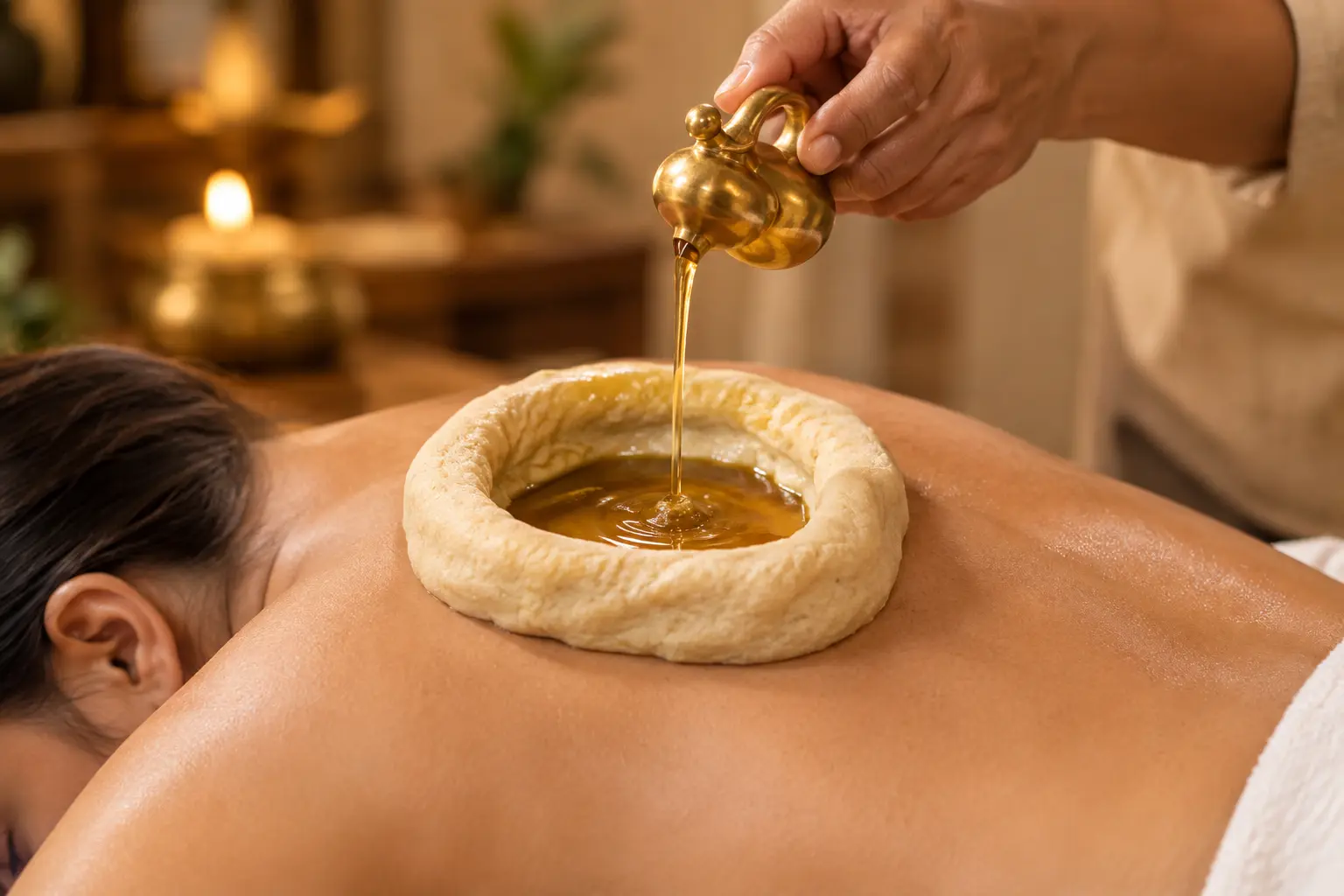
Warm oil retained over a specific area
Bāhya Basti involves retaining warm Ayurvedic oil over a defined area of the body within a soft ring. The oil, temperature and duration are personalised according to the area being treated and your sensitivity.
 Bāhya Basti — localised Ayurvedic oil treatments
Kati Basti — lower back
Warm oil is retained over the lumbar region.
Traditional indications:
- Kaṭi Śūla — lower-back pain.
- Kaṭigraha — lower-back stiffness.
- Postural fatigue.
- Localised Vata disturbance in the lumbosacral region.
- Gridhrasī — sciatica-type pain, following assessment.
Griva Basti / Manya Basti — neck and cervical area
Warm oil is retained over the neck and upper back.
Traditional indications:
- Manyāstambha — cervical stiffness.
- Grīvāgraha — restricted movement or tension in the neck.
- Upper-back fatigue.
- Postural tension in the neck and shoulder-blade area.
- Tension associated with prolonged desk or screen work.
Janu Basti — knees
Warm oil is retained around one or both knees.
Traditional indications:
- Jānu Śūla — knee pain.
- Jānu Stambha — knee stiffness.
- Sandhigata Vāta affecting the knee.
- Joint discomfort with crepitus.
- Reduced mobility in a degenerative context, after medical and Ayurvedic assessment.
Hrid Basti — chest area
Warm oil is applied gently over the chest area.
Traditional indications:
- Functional tension in the precordial or chest area.
- Vata-related restlessness.
- Non-urgent chest tightness associated with stress, after medical causes have been excluded.
- Need for calm and deep relaxation.
Hrid Basti does not treat heart disease and must never be used for unexplained chest pain. Acute or unusual chest pain requires immediate medical assessment.
Nabhi Basti / Udara Basti — abdomen
Warm oil is retained around the navel or over a specific part of the abdomen.
Traditional indications:
- Functional abdominal tension.
- Bloating and gas associated with a Vata imbalance.
- Irregularity of Apāna Vāta.
- Need for relaxation in the digestive area.
- Personalised Ayurvedic support for digestion.
Acute abdominal pain, fever or unexplained digestive symptoms require medical advice before treatment.
Local external Basti therapies — Kati, Griva, Janu, Hrid and Nabhi Basti — are later clinical developments based on the classical principles of Snehana, or oleation, and Swedana, or therapeutic heat
Pichu
Warm Ayurvedic oil compress
Pichu is a soft compress soaked in warm Ayurvedic oil and placed over a specific area to provide gentle, sustained local application.
Traditional Ayurvedic indications:
- Manyāstambha and Grīvāgraha — neck stiffness or tension.
- Kaṭi Śūla — lower-back pain and tension.
- Sandhi Śūla — joint pain.
- Sandhi Stambha — joint stiffness.
- Localised Vata-related dryness, sensitivity or degeneration.
- Areas requiring a gentle, prolonged application of medicinal oil.
.webp) Pichu
Pichu
Pichu may be used alone or combined with massage, local Basti or Ayurvedic heat therapy.
Ayurvedic therapies for the head and senses
Nasya
Traditional Ayurvedic nasal therapy
Nasya is the controlled administration of a selected Ayurvedic preparation through the nostrils, usually following a gentle massage of the face, neck and shoulders.
Traditional Ayurvedic indications:
- Pinasa — chronic nasal congestion or rhinitis outside an acute infection.
- Śirogaurava — heaviness of the head.
- Śirośūla — selected headache patterns after medical diagnosis.
- Ardhāvabhedaka — selected migraine patterns after medical diagnosis.
- Manyāstambha and Grīvāroga — stiffness and disorders of the neck and cervical region.
- Nasal dryness and Vata imbalances affecting the nasal passages.
- Conditions of the head and structures above the shoulders, according to the prescribed type of Nasya.
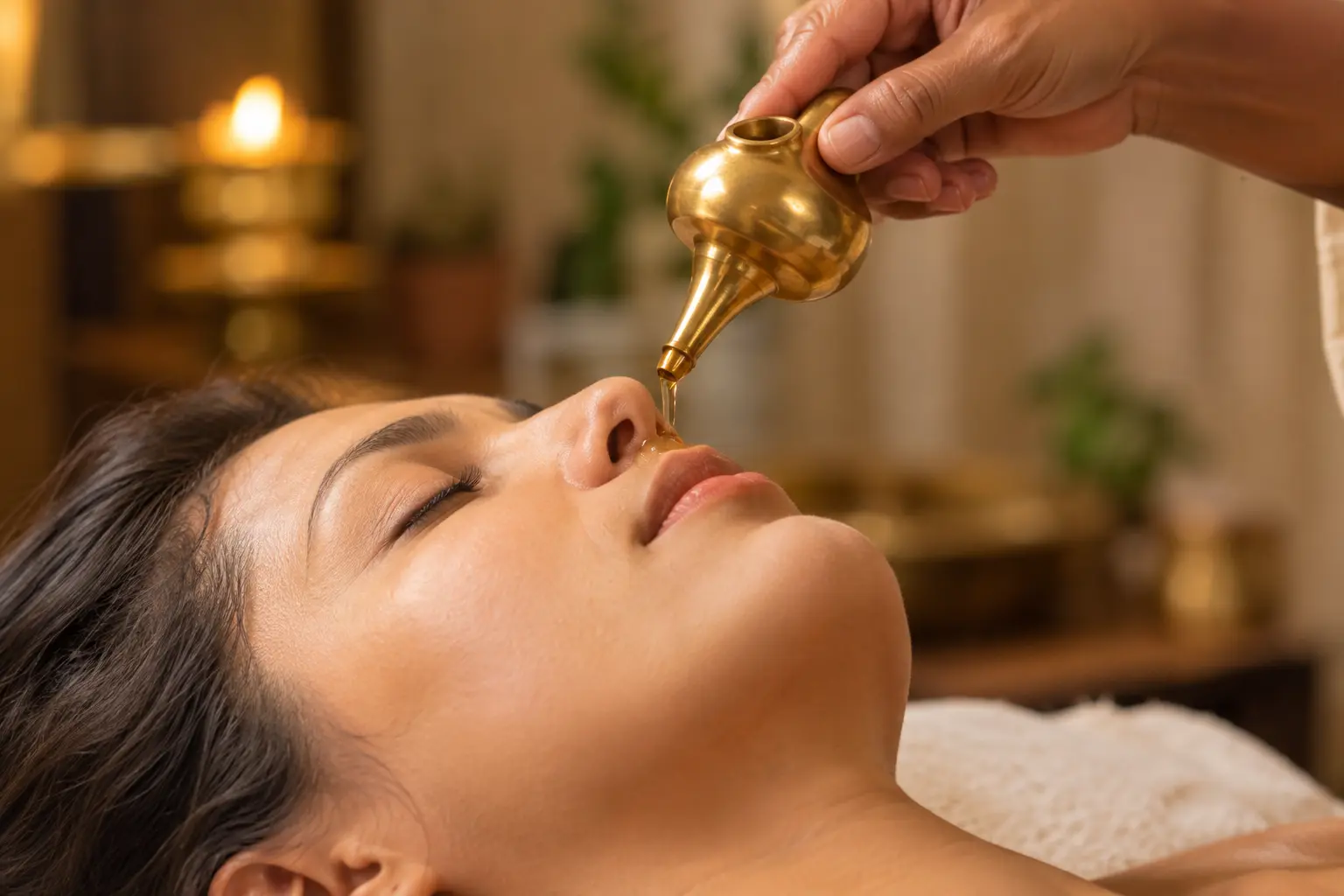 Nasya
Nasya
The type of Nasya, preparation and dose are personalised. Treatment is postponed in cases of nosebleed, acute infection or following certain ear, nose and throat procedures.
Nasya: Aṣṭāṅga Hṛdaya, Sūtra Sthāna, Chapter 20, together with corresponding teachings in the Caraka Saṃhitā.
Karna Purana
Ayurvedic ear care with warm oil
Karna Purana is the careful application of selected warm Ayurvedic oil to the external ear canal. The treatment is adapted to the condition and sensitivity of the area.
Traditional Ayurvedic indications:
- Karna Rukṣatā — dryness of the external ear canal.
- Karna Śūla — ear pain or discomfort after an acute cause has been excluded.
- Karna Nāda — Vata-dominant tinnitus, alongside an appropriate ENT assessment.
- Tension around the jaw and temporo-auricular area.
- Traditional ear care and calming of Vata.
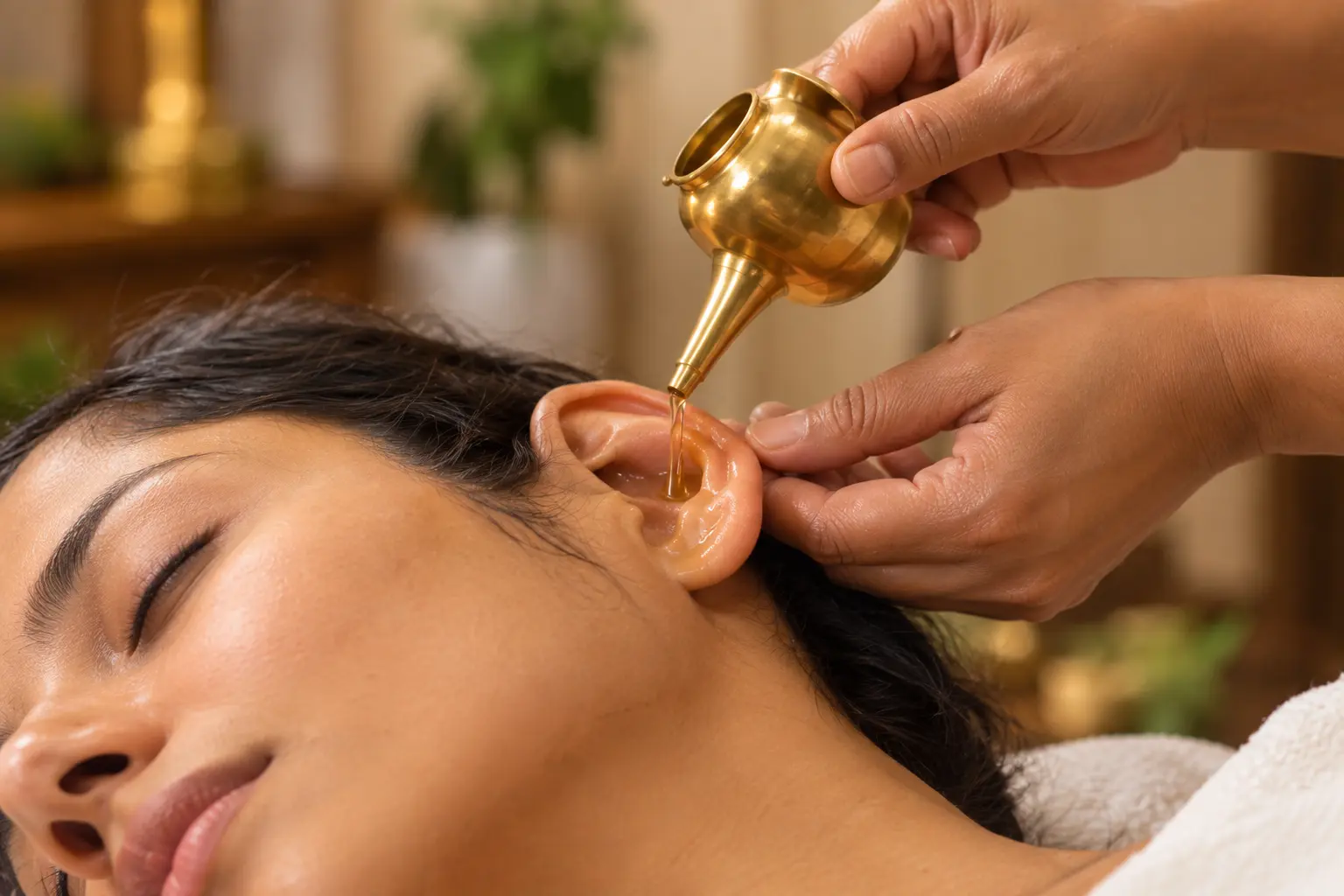 Karna Purana
Karna Purana is not performed in cases of acute pain, discharge, infection, known perforation of the eardrum or sudden hearing loss.
Shiro Basti
Ayurvedic oil treatment for the head
Shiro Basti uses a fitted cap to retain warm Ayurvedic oil over the upper part of the head for a defined period.
Traditional Ayurvedic indications:
- Anidrā — difficulty falling asleep or disturbed sleep.
- Śirośūla — chronic headaches after medical diagnosis.
- Manyāstambha — Vata-related neck stiffness.
- Dryness of the scalp.
- Localised Vata disorders affecting the head.
- Mental restlessness and nervous fatigue.
- Need for deep relaxation.
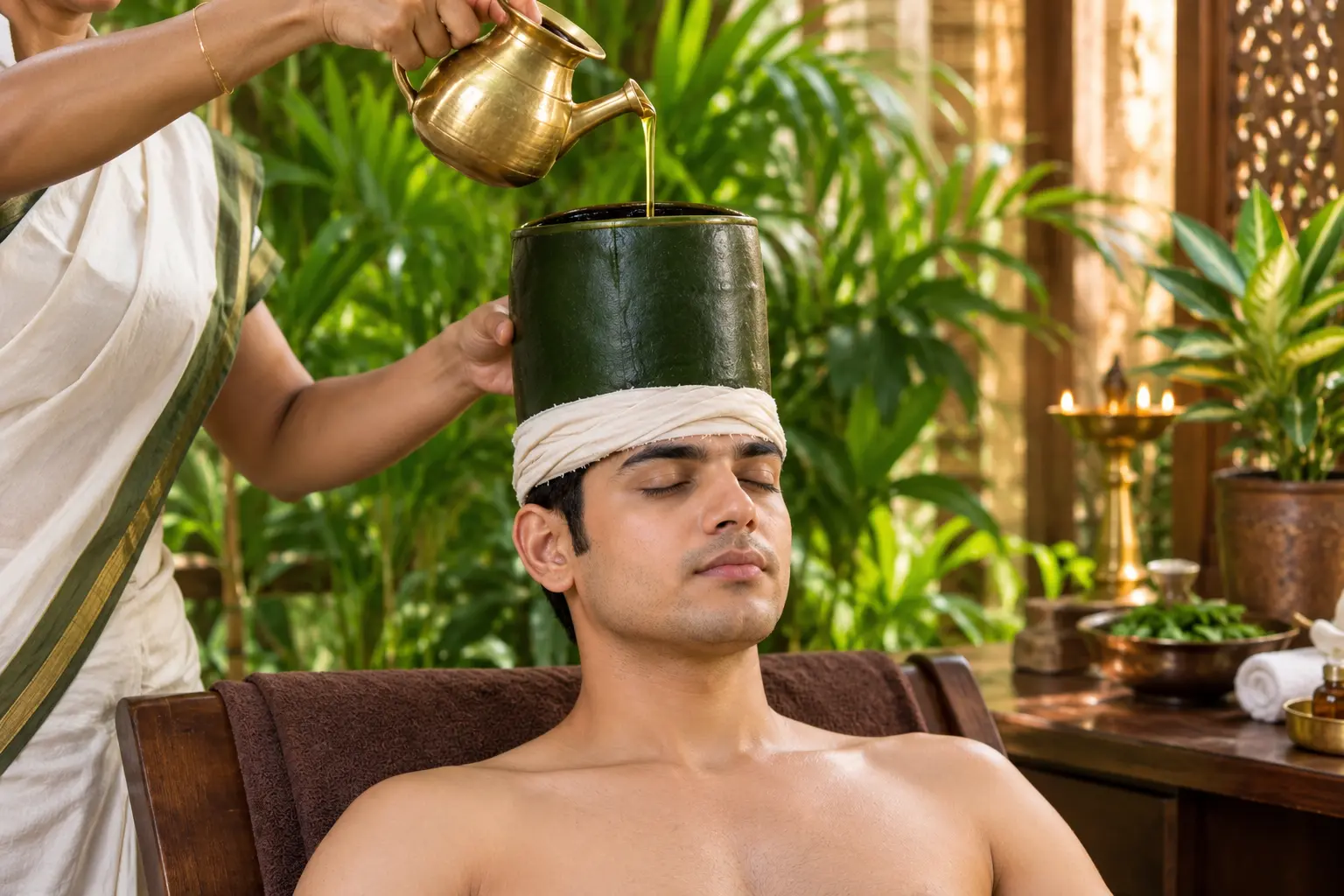 Shiro Basti
The oil, temperature and duration are adapted to your constitution, general health and tolerance of heat.
Herbal applications, bolus therapies and heat treatments
Lepa and Upanaha
Localised Ayurvedic herbal pastes and poultices
Lepa is a paste made from selected Ayurvedic herbs and powders and applied to a specific area. Upanaha is a poultice, usually warm, that remains over a muscle or joint for a longer period.
Traditional Ayurvedic indications:
- Śūla — localised muscle or joint pain.
- Stambha — stiffness and restricted movement.
- Śotha — local swelling, using a warming or cooling preparation according to the stage of the condition.
- Sandhigata Vāta — degenerative joint discomfort dominated by Vata.
- Selected skin conditions requiring a local herbal application.
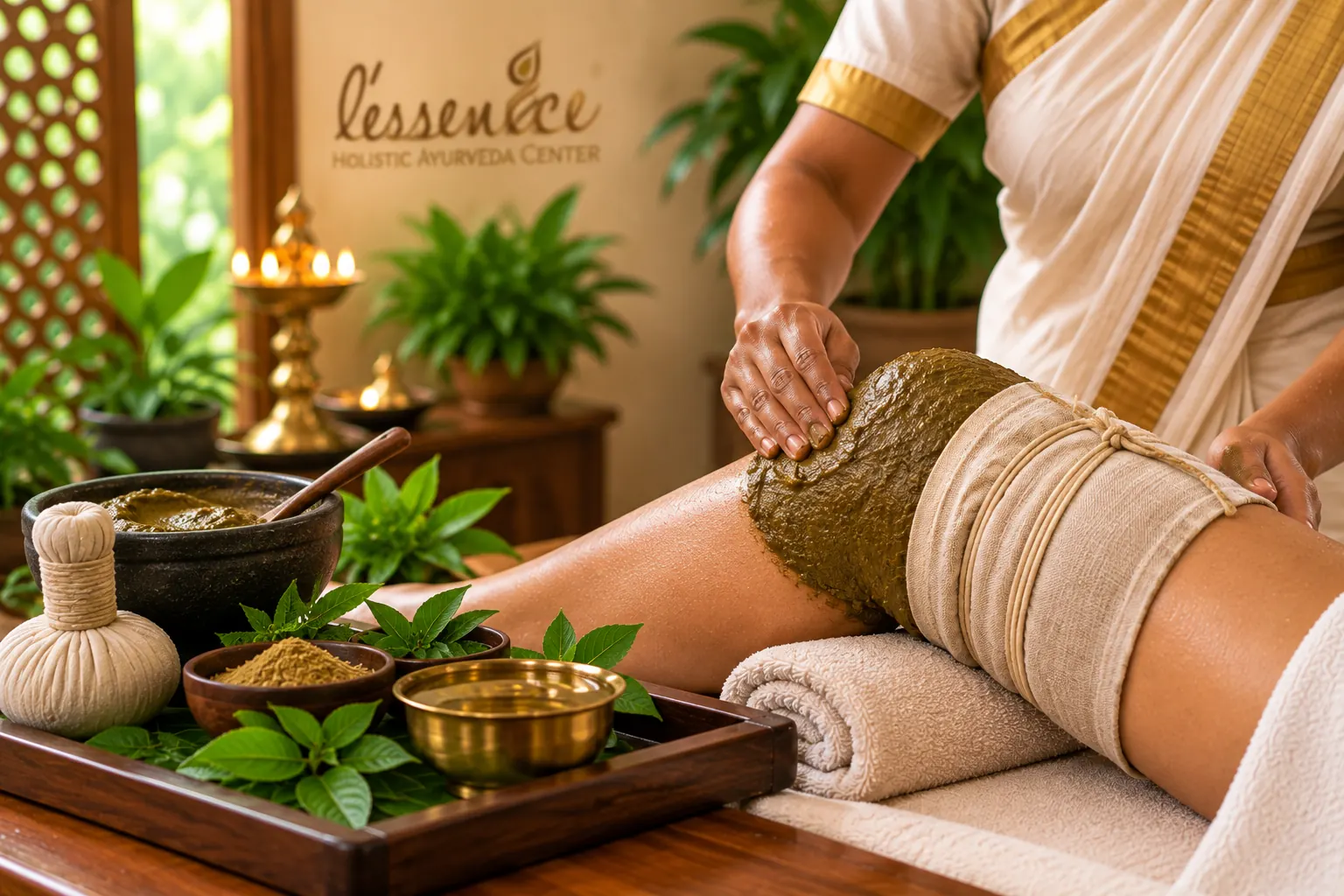 Lepa and Upanaha
Lepa is used when a herbal paste needs to act directly on a specific area.
Upanaha is used when gentle warmth, prolonged application and local support are required.
The ingredients, temperature and duration are personalised. Skin condition, known allergies and sensitivity to heat are checked beforehand.
Navarakizhi / Shashtika Shali Pinda Sweda
Nourishing Ayurvedic massage with medicinal rice boluses
Navarakizhi, also known as Njavarakizhi or Shashtika Shali Pinda Sweda, is a traditional Kerala therapy. A special rice known as Navara or Shashtika Shali is cooked with milk and a herbal decoction, then placed in cloth boluses. The warm boluses are applied rhythmically over the body or a selected area. This combination of heat, massage and medicinal rice distinguishes Navarakizhi from other herbal Pinda Sweda treatments.
Traditional Ayurvedic indications:
- Māṃsa Kṣaya — loss of muscle mass and strength.
- Daurbalya — weakness, exhaustion or convalescence.
- Stambha — muscular and joint stiffness.
- Vata-dominant degenerative conditions involving dryness, weakness and reduced mobility.
- Recovery after immobilisation, alongside rehabilitation.
- Pakṣāghāta and other neuromuscular presentations, within a programme coordinated with medical care.
- Bṛṃhaṇa — the Ayurvedic indication for nourishing, strengthening and revitalising the tissues.
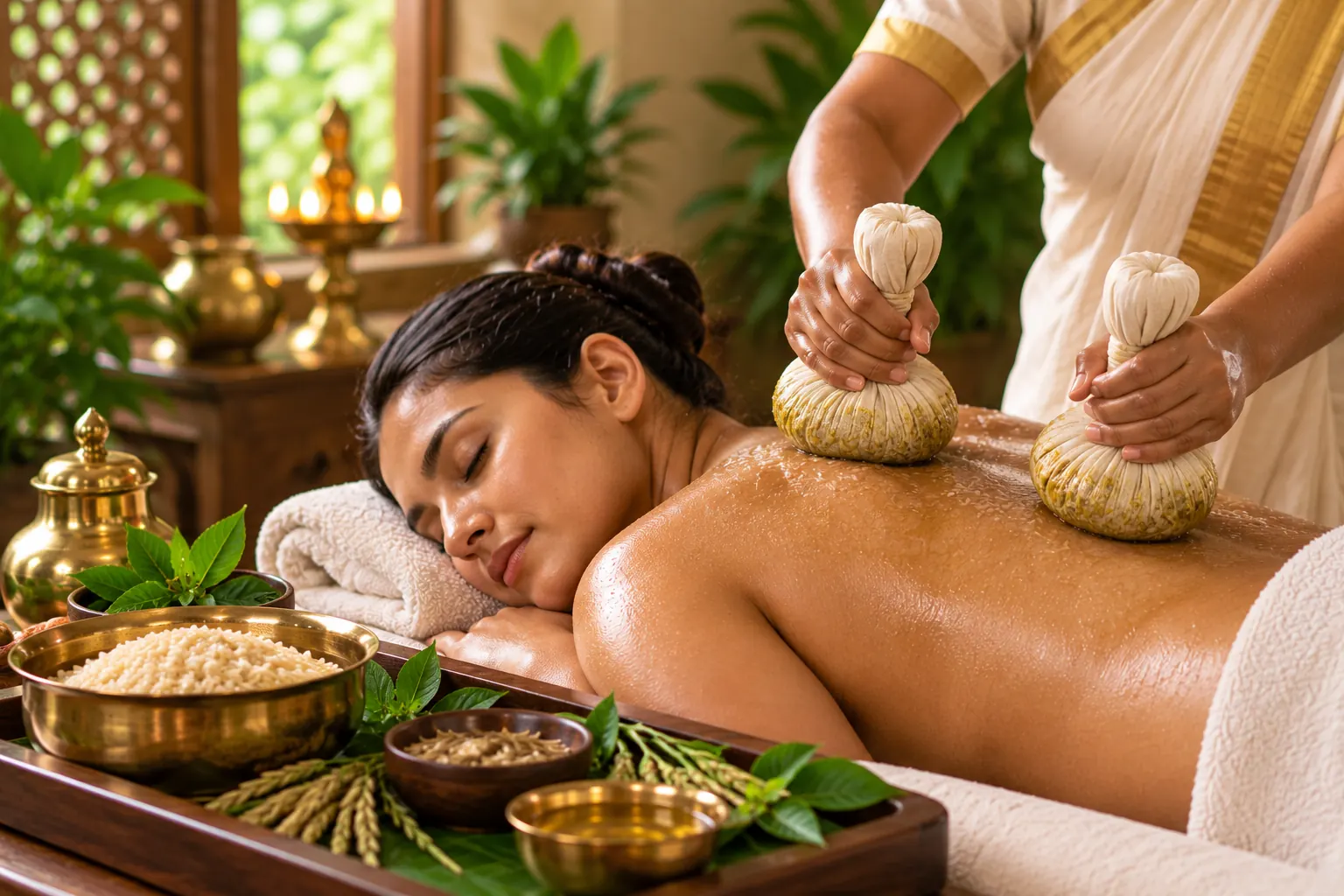 Navarakizhi / Shashtika Shali Pinda Sweda
How the treatment is performed:
- 1. Application of a selected Ayurvedic oil.
- 2. Preparation of the medicinal rice boluses.
- 3. Rhythmic massage with the boluses at a carefully controlled temperature.
- 4. Cleansing of the skin.
- 5. Rest after treatment.
The treatment is adapted or postponed in cases of fever, infection, acute inflammation, wounds, active skin disease, poor tolerance of heat or recent surgery. Tell the practitioner about any allergy to milk, rice, herbs or oils. Navarakizhi may support recovery, but it does not replace rehabilitation, neurological diagnosis or prescribed medical treatment.
Navarakizhi / Shashtika Shali Pinda Sweda belongs primarily to the Kerala therapeutic tradition.
Swedana and Avagaha Sweda
Personalised Ayurvedic heat, steam and warm-bath therapies
Swedana includes Ayurvedic therapies that use controlled heat or steam to warm the whole body or a specific area. It is commonly performed after an oil massage or as preparation for selected Panchakarma procedures. Avagaha Sweda is a localised form of Swedana in which the selected area is immersed in a warm liquid preparation chosen after the Ayurvedic assessment.
Traditional Ayurvedic indications:
- Stambha — muscular or joint stiffness.
- Gaurava — physical heaviness.
- Śīta — general or localised coldness.
- Śūla — pain associated with a Vata or Kapha imbalance.
- Muscular tension and reduced mobility.
- Stiffness or pain affecting the pelvis and lower body.
- Selected perineal or anorectal tension, following assessment.
- Preparation of the body before selected Panchakarma procedures.
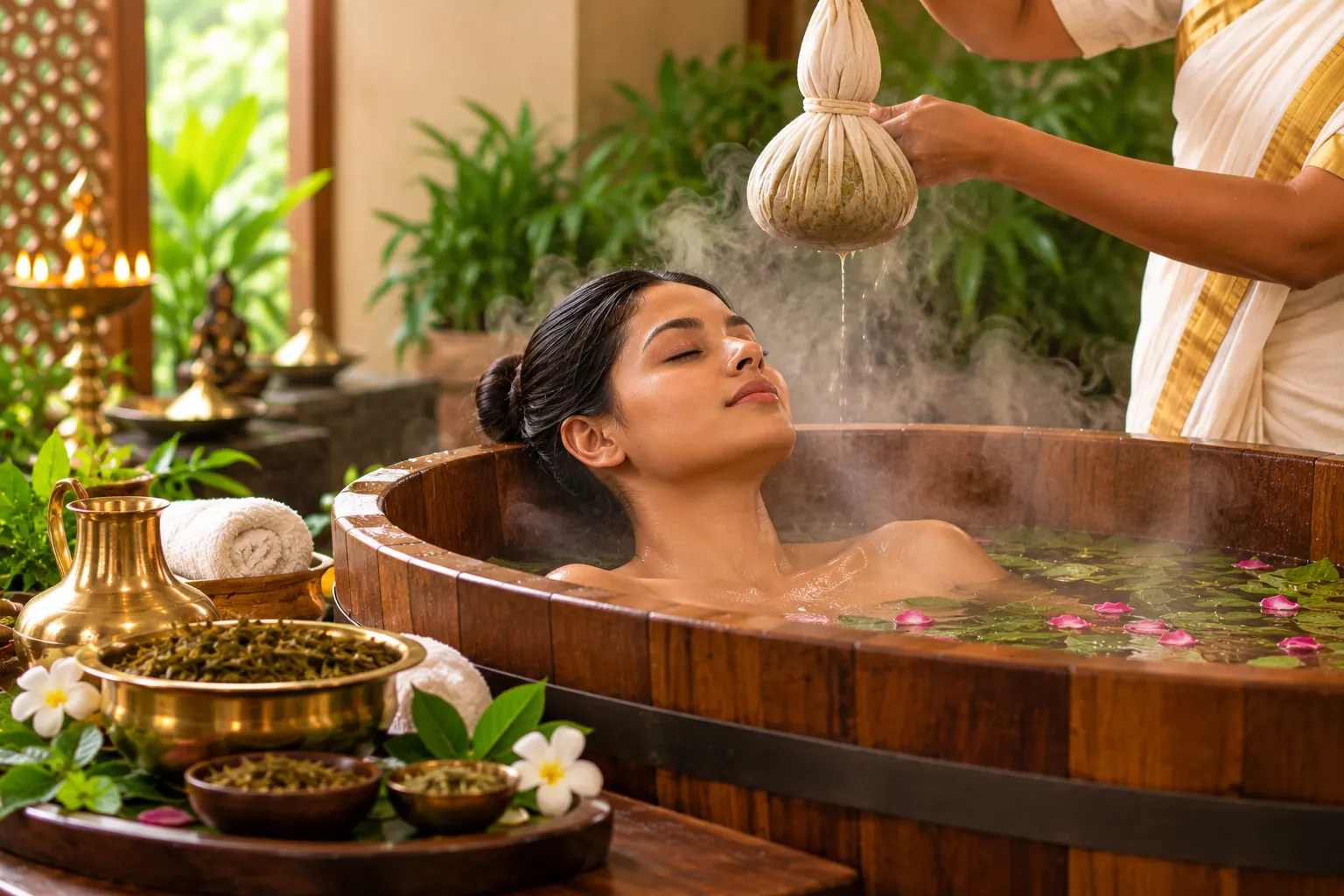 Swedana and Avagaha Sweda
The method, preparation, temperature and duration are personalised. Treatment is adapted or postponed in cases of fever, dehydration, pregnancy, marked weakness, poor tolerance of heat or unstable cardiovascular disease.
Swedana: Caraka Saṃhitā, Sūtra Sthāna, Chapter 14 — the management of Stambha, Gaurava, Śīta and Śūla through appropriately selected sudation.
Takradhara
Continuous flow of a traditional Ayurvedic buttermilk preparation
Takradhara uses a continuous, rhythmic flow of a traditional buttermilk-based preparation, usually over the forehead. It differs from Shirodhara, which generally uses Ayurvedic oil.
Traditional Ayurvedic indications:
- Heat in the head associated with aggravated Pitta.
- Anidrā — disturbed sleep or difficulty falling asleep.
- Mental fatigue.
- Irritability and restlessness.
- Selected Pitta-dominant conditions of the scalp or skin, according to the preparation used.
- Need for a calming therapy when oil-based Shirodhara is not the most appropriate choice.
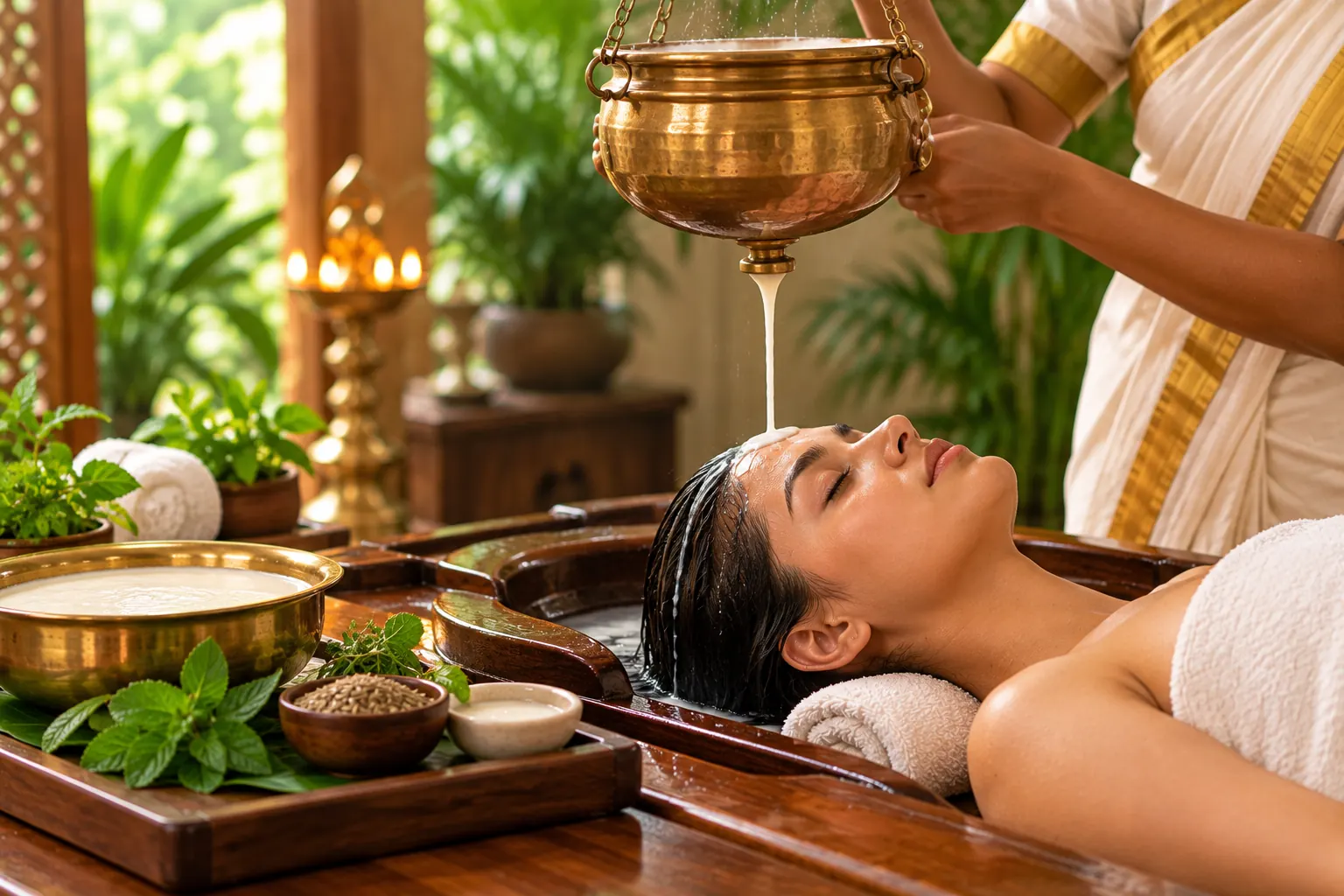 Takradhara
The choice between Takradhara and Shirodhara depends on your constitution, the season, your needs and any contraindications.
Specialised Ayurvedic procedures
Agnikarma
Highly localised Ayurvedic thermal stimulation
Agnikarma is a specialised procedure that applies precise, brief heat to points selected by the practitioner. It is neither a massage nor a relaxation treatment.
Traditional Ayurvedic indications:
- Ati-Ugra Ruja — intense, clearly localised pain.
- Snāyu Vikāra — painful disorders affecting tendons or ligaments.
- Sandhi Vikāra — painful joint disorders.
- Sandhigata Vāta — degenerative joint pain and stiffness.
- Gridhrasī — sciatica-type pain after differential diagnosis.
- Localised muscular or bone pain described by Suśruta within the scope of Agnikarma.
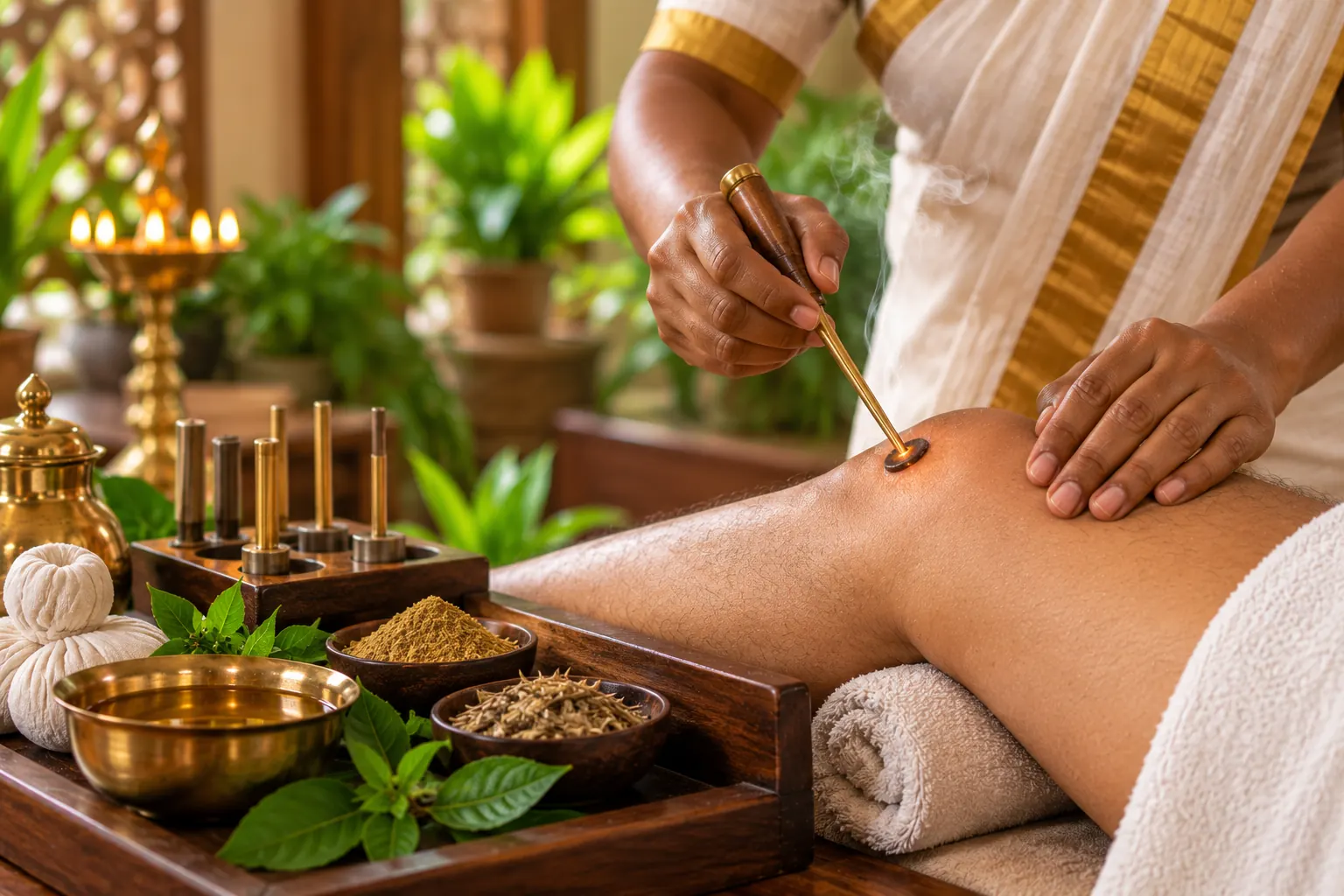 Agnikarma
The classical texts describe additional surgical applications of Agnikarma. These are not included among the indications offered on this page.
A prior consultation, screening for contraindications and your informed consent are mandatory. Local warmth, redness or a skin reaction may occur after the procedure.
Agnikarma: Suśruta Saṃhitā, Sūtra Sthāna, Chapter 12 — indications and method for controlled thermal application.
Viddha Karma / Viddha Chikitsa
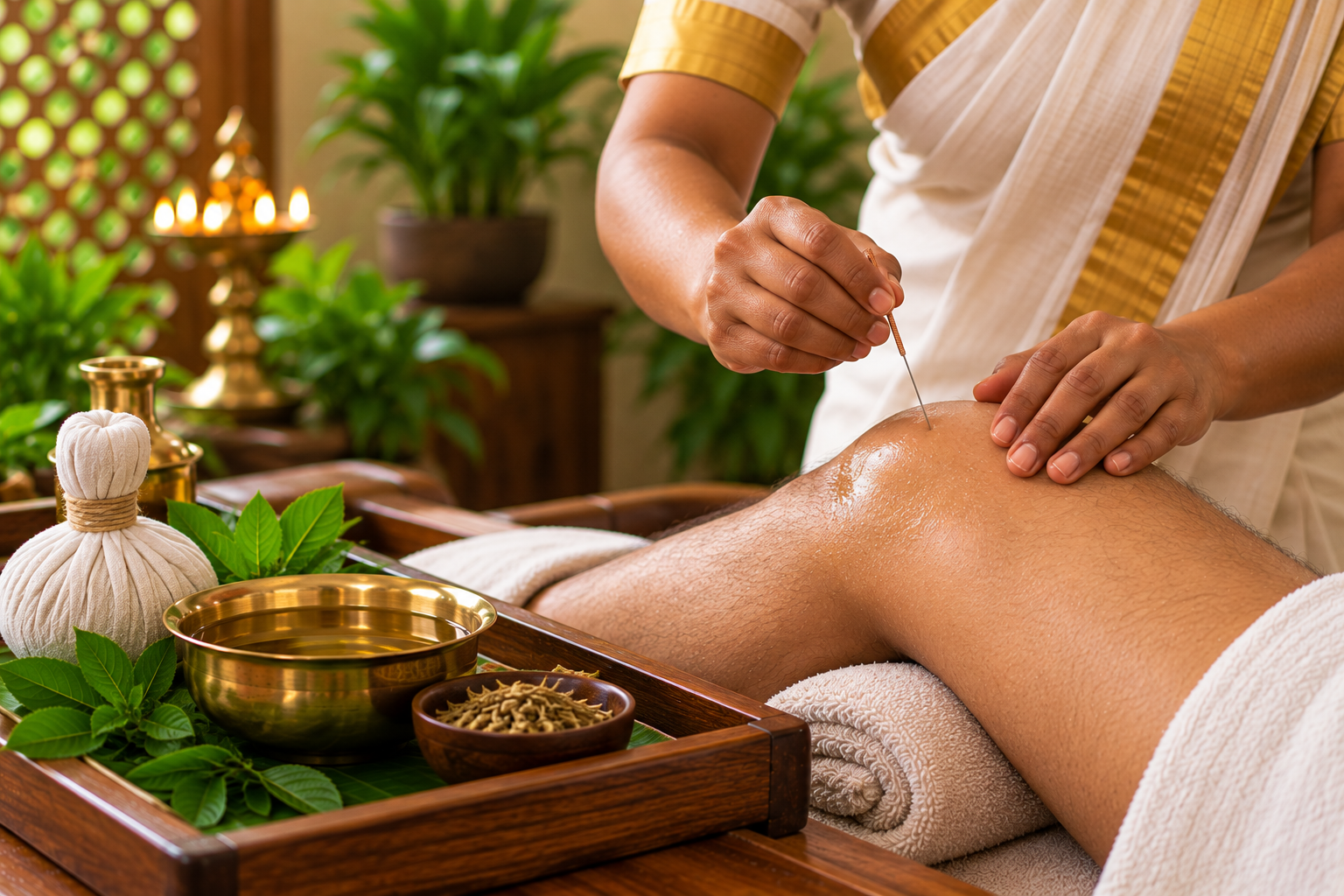
Stimulation of selected points with a sterile needle
Viddha Karma is a traditional Ayurvedic procedure involving superficial stimulation of carefully selected points. Its protocol is distinct from massage and should not be confused with modern acupuncture.
Traditional Ayurvedic indications:
- Śūla — precise, localised pain.
- Gridhrasī — sciatica-type pain.
- Manyāstambha — cervical stiffness.
- Sandhigata Vāta — degenerative joint pain or stiffness.
- Ardhāvabhedaka — selected migraine patterns after medical diagnosis.
- Persistent muscular tension.
- Functional limitation associated with a specific point.
 Viddha Karma / Viddha Chikitsa
Viddha Karma as practised today is a clinical application of Vedhana principles described in the Suśruta tradition. It should not be presented as identical to acupuncture.
Viddha Karma, also known as Vedhana Karma or Sūcī Vedhana, is an Ayurvedic technique involving the controlled stimulation of selected points with a sterile needle.
The procedure is performed only after screening for bleeding, infection and poor-healing risks. Sterile, single-use equipment and informed consent are required.
Viddha Karma: based on Vedhana — controlled puncturing — described among the eight procedures of Śastra Karma in the Suśruta Saṃhitā, Sūtra Sthāna 5.5, and on the principles of Sirāvyadha set out in Śārīra Sthāna, Chapter 8.
Dhūpana and Dhūmapāna
External Ayurvedic fumigation and specialised medicinal-smoke inhalation
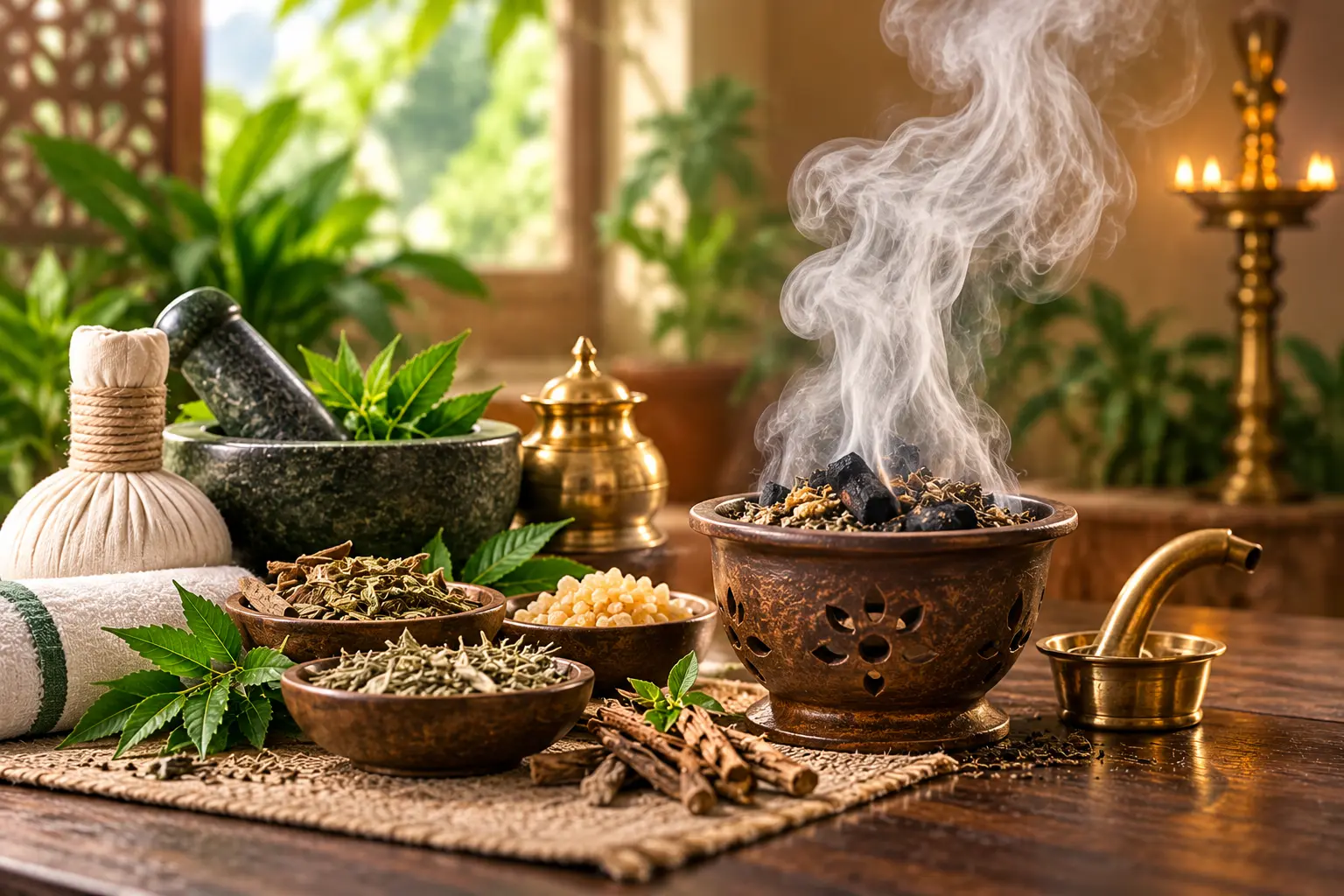
Dhūpana and Dhūmapāna both use smoke produced by the controlled combustion of selected Ayurvedic preparations. Despite this shared origin, they are different practices with different indications and safety considerations.
 Dhūpana and Dhūmapāna
Dhūpana — external Ayurvedic fumigation
Dhūpana disperses smoke from a plant-based preparation into a room, around an object or, in selected protocols, near an external area of the body. The smoke is not intentionally inhaled.
Traditional indications:
- Preparing the treatment environment for selected Ayurvedic therapies.
- Traditional fumigation of the room or equipment.
- Odour control.
- Supporting a precisely selected external protocol.
Dhūpana does not replace cleaning, professional disinfection, ventilation or the centre’s hygiene procedures.
Dhūmapāna — specialised Ayurvedic smoke inhalation
Dhūmapāna involves the controlled inhalation and exhalation of smoke from a selected preparation. In the Ayurvedic tradition, it is associated with certain Vata and Kapha imbalances affecting the head, nose and throat.
Traditional indications:
- Heaviness of the head.
- Mucus accumulation identified during the Ayurvedic assessment.
- Non-acute functional nasal congestion.
- A sensation of mucus or obstruction in the throat.
- Selected protocols performed after Nasya.
Dhūmapāna is not a “lung detox” and does not treat asthma, respiratory infection or ENT disease. Smoke may irritate the eyes and airways. This procedure is avoided in cases including asthma, respiratory allergy, acute cough or infection, pregnancy, bleeding, marked dryness, dizziness or respiratory sensitivity.
Dhūmapāna: Aṣṭāṅga Hṛdaya, Sūtra Sthāna, Chapter 21 — indications, administration and contraindications for medicinal smoke.
Personalised Protocol
How is your Ayurvedic therapy selected?
A clear and secure path, tailored to your needs.
At L’essencce, Ayurvedic treatments are never applied as a standard protocol. Your therapy is selected according to your concerns, constitution, current health and the precautions required.
01
Your needs
The practitioner asks about your symptoms, how they have changed, your medical diagnoses, current medication and expectations.
02
Ayurvedic assessment
The assessment considers your individual constitution, the Dosha, Agni — your digestive and metabolic capacity — Ama, the tissues involved and the location of the imbalance.
03
Precautions
Known allergies, skin or circulatory conditions, pregnancy, recent procedures, sensitivity to heat and medication such as anticoagulants are reviewed before treatment.
04
Personalised protocol
The therapy, oil or preparation, temperature, intensity and duration are adapted to your situation. The practitioner determines whether one session is sufficient or whether a progressive programme is more appropriate.
05
Follow-up
Your response and progress are reviewed. When appropriate, the protocol may be adjusted and supported by recommendations concerning diet, daily routine, Ayurvedic herbal medicine or other therapies.
Session Journey
Before, during and after your session
Preparation
Before your session
Tell the practitioner about your medication, allergies, circulatory problems, possible pregnancy and recent medical procedures. Bring any relevant medical information. You may be advised to avoid a heavy meal immediately before your appointment.
During treatment
During your session
You are positioned comfortably and each step is explained. Temperature, pressure, intensity and comfort are monitored throughout. Tell the practitioner immediately if you experience any unusual or uncomfortable sensation.
Post-care & Advice
After your session
A short rest period may be recommended. You will receive personalised advice about showering, food, physical activity, exposure to cold or sunlight and, where necessary, observation of the treated area.
Therapeutic Framework & Vigilance
Safety, precautions and limits of care
Safe, responsible and transparent practice adhering to Swiss healthcare standards.
Fundamental Principle
A complementary and non-invasive approach
The Ayurvedic therapies offered at L’essencce are complementary healthcare approaches. They do not replace medical diagnosis, prescribed treatment or follow-up with your doctor or specialist.
Precautions & Transparency
An essential preliminary discussion
Before your session, tell the practitioner about diagnosed conditions, medication, allergies, possible pregnancy and recent medical procedures. This information allows the therapy to be adapted or postponed and, when necessary, enables referral to an appropriate healthcare professional.
When should you seek medical advice before treatment?
Medical assessment is required if you have:
Medical Emergency in Switzerland
In a medical emergency in Switzerland, call 144.
Excellence & Cadre Professionnel Suisse
Care supervised by a qualified Ayurvedic practitioner
Safe practice and professional care
Praticien Diplômé Fédéral
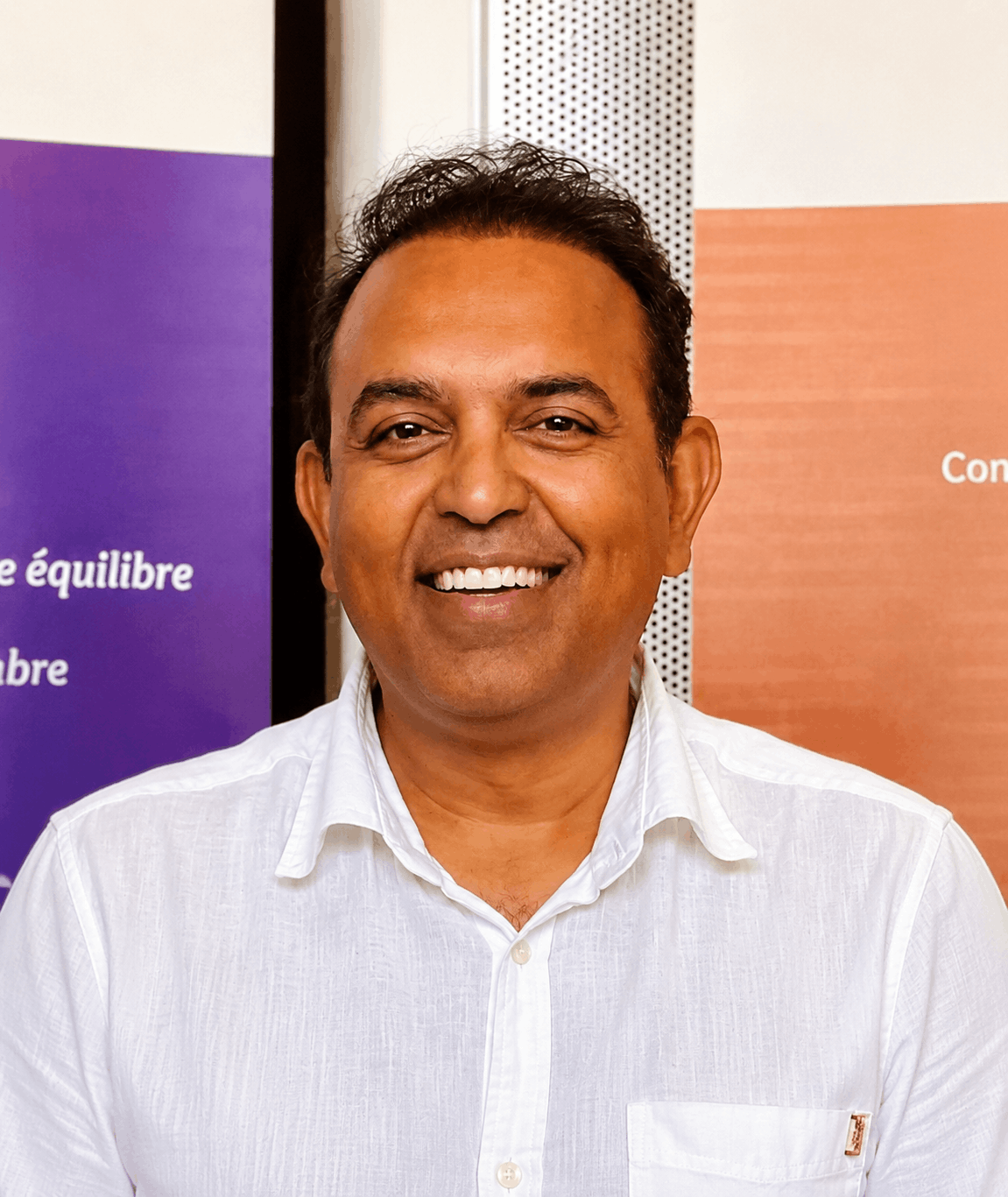
Vaidya Yogeet Kapoor
Ayurvedacharya (Inde) · Diplôme Fédéral (Suisse)
Specialised Ayurvedic therapies are assessed or supervised by Vaidya Yogeet Kapoor, an Ayurvedacharya trained in India and a naturopath with a Swiss federal diploma in Ayurvedic medicine.
His approach combines the traditional principles of Ayurveda with individual assessment, strict hygiene requirements and the Swiss professional framework.
Learn about Yogeet Kapoor’s qualifications
.png)
Vaidya Yogeet Kapoor
Experienced practitioner trained in Ayurveda
Strict hygiene and safety standards
Complementary and respectful approach
Individualised and supportive care
« Caring for each individual with authenticity, rigour and compassion. »
— The L’essencce Team
Location & Access
Ayurvedic therapies in Nyon and French-speaking Switzerland
In the heart of La Côte, halfway between Geneva and Lausanne.
Canton of Vaud · La Côte
L’essencce – Centre for Ayurvedic Medicine
L’essencce – Centre for Ayurvedic Medicine is located in Nyon, in the heart of La Côte, between Geneva and Lausanne. The centre welcomes patients from Nyon, Prangins, Gland, Rolle, Coppet, Founex, Versoix, Morges and throughout French-speaking Switzerland.
Specialised Ayurvedic treatments are available by appointment. Some non-invasive therapies may be booked after a brief preliminary check. An initial Ayurvedic consultation is mandatory for Agnikarma, Viddha Karma and other procedures requiring an in-depth assessment.

Easy Access
5–10 min from Nyon railway station
Easy access from Geneva and Lausanne
Answers & Advice
Frequently asked questions about Ayurvedic therapies
Clear answers to help you prepare your therapy with complete peace of mind
What is the difference between Ayurvedic massage and a specialised Ayurvedic therapy?
Ayurvedic massage usually treats a broad area or the whole body. A specialised therapy such as Netra Basti, Kati Basti, Nasya or Agnikarma uses a specific technique for a defined area and a traditional indication assessed by the practitioner.
Do I need a consultation before booking an Ayurvedic therapy?
Some non-invasive treatments can be booked after a brief preliminary check. An Ayurvedic consultation is mandatory before Agnikarma, Viddha Karma and other specialised procedures so that the indication, medication and contraindications can be reviewed.
What is the difference between Kati Basti, Griva Basti and Janu Basti?
All three therapies retain warm Ayurvedic oil over a specific area. Kati Basti treats the lower-back area, Griva Basti the neck and cervical area, and Janu Basti one or both knees.
What is the difference between Agnikarma and Viddha Karma?
Agnikarma uses brief, highly localised thermal stimulation. Viddha Karma stimulates selected points with a sterile needle. Both are reserved for precise indications and require a professional assessment before treatment.
How should I prepare for an Ayurvedic therapy?
Avoid a heavy meal immediately before the appointment and wear comfortable clothing. Tell the practitioner about medication, allergies, possible pregnancy and recent medical procedures. Before Netra Basti, remove contact lenses and avoid eye make-up.
How many Ayurvedic therapy sessions will I need?
The number of sessions depends on the therapy, how long your symptoms have been present and your response to treatment. A therapy may be used once or as part of a planned series. The protocol is reviewed regularly.
Can Ayurvedic therapy be combined with medical treatment?
Yes. These therapies can complement medical care, but they do not replace diagnosis or prescribed treatment. Never stop medication without consulting the healthcare professional who prescribed it, and tell the Ayurvedic practitioner what you are taking.
Are Ayurvedic therapies covered by health insurance in Switzerland?
Reimbursement depends on the invoiced method, the practitioner’s registration and your supplementary insurance policy. Professional registration does not guarantee that every treatment is covered. Confirm your cover directly with your insurer before booking an Ayurvedic therapy in Nyon.